How to Pray the Angelus
The Angelus is a short (~90-second) Catholic prayer traditionally said three times a day — 6 AM, noon, 6 PM — that meditates on the moment the angel told Mary she would bear Christ. Below are the full words, what each line means, and how to build the habit into a working day.
Most Catholics have heard of the Angelus. Many grew up with it somewhere — a church bell at noon in a town square, a grandparent who paused mid-sentence at six in the evening, a boarding school that rang bells three times a day. Most also never learned the actual words, or learned them in another language, or lost them somewhere along the way.
This post contains the full prayer, the timing, the history, and a plain-English account of how to make this a real part of a working weekday. It is one of the shortest, oldest habits the Catholic Church offers — and one of the easiest to start.
What is the Angelus?
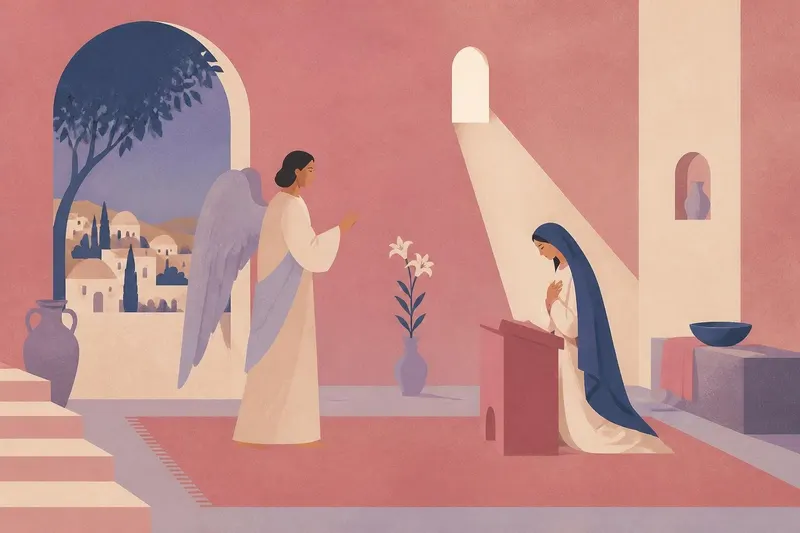
The Angelus is a short Catholic devotion — about ninety seconds — that meditates on the Annunciation, the moment the angel Gabriel told Mary she would bear the Son of God (Luke 1:26–38). It is made up of three versicles (short spoken lines with responses), three Hail Marys, and a closing prayer.
The prayer takes its name from its opening line in Latin: Angelus Domini nuntiavit Mariae — "The angel of the Lord declared unto Mary." Traditionally it is prayed three times a day, often accompanied by a church bell rung in sets of three strokes.
Pope Paul VI, in his 1974 apostolic exhortation Marialis Cultus, describes the Angelus as a prayer that "has stood the test of time because of its simplicity" and calls it a simple but earnest practice that Catholics should continue "wherever and whenever possible."
When do Catholics pray the Angelus?
Three times a day, at traditional hours:
- 6:00 AM — the start of the working day
- Noon — the midpoint, the lunch-time bell
- 6:00 PM — the end of the working day
These hours predate any modern clock. They mark the three hinges of a pre-industrial workday: rising, midday rest, and the close of work. The practice is to pause — whatever you are doing — say the prayer, and continue. In monasteries, at convents, and still in a handful of traditionally Catholic countries, a bell rings at these hours to call the faithful to pause.
If you cannot pray it at all three hours, the middle one (noon) is the most common choice. If noon does not work, any single time you can keep consistently is better than a sporadic three.
What are the actual words?
The prayer has a fixed, brief form. It goes like this:
V. The angel of the Lord declared unto Mary.
R. And she conceived of the Holy Spirit.
Hail Mary, full of grace, the Lord is with thee; blessed art thou amongst women, and blessed is the fruit of thy womb, Jesus. Holy Mary, Mother of God, pray for us sinners, now and at the hour of our death. Amen.
V. Behold the handmaid of the Lord.
R. Be it done unto me according to thy word.
Hail Mary…
V. And the Word was made flesh.
R. And dwelt among us.
Hail Mary…
V. Pray for us, O holy Mother of God.
R. That we may be made worthy of the promises of Christ.
Let us pray: Pour forth, we beseech thee, O Lord, thy grace into our hearts; that we, to whom the Incarnation of Christ thy Son was made known by the message of an angel, may by his Passion and cross be brought to the glory of his Resurrection, through the same Christ our Lord. Amen.
That is the whole prayer. The three versicles walk through the Annunciation — the angel's announcement, Mary's consent, and the Incarnation ("And the Word was made flesh," from John 1:14). Each is followed by a Hail Mary. The closing prayer ties the whole into the arc of salvation: Incarnation, Passion, Resurrection.
What does each part of the Angelus mean?
Each versicle is a small door into a specific moment of Catholic theology. It is worth knowing what you are actually praying.
"The angel of the Lord declared unto Mary. And she conceived of the Holy Spirit." This is the Annunciation — Gabriel's visit to Mary, recorded in Luke 1. The prayer affirms two claims in one line: that the message to Mary was a real revelation from God, not a private religious experience, and that what took place in her womb was the direct work of the Holy Spirit, not a human initiative. The Hail Mary that follows is Gabriel's own greeting to her: "Hail, full of grace, the Lord is with thee" (Luke 1:28).
"Behold the handmaid of the Lord. Be it done unto me according to thy word." This is Mary's reply — her consent, her fiat. The Catholic tradition treats this moment as the hinge of history: the Incarnation happens because Mary freely says yes. The second Hail Mary remembers that this was a real woman, in a real town, giving a real answer to a real question.
"And the Word was made flesh. And dwelt among us." This is the line from John 1:14, and it is the whole point. The Incarnation is not a metaphor and not a spiritual abstraction. God, without ceasing to be God, took on human flesh inside a specific young woman at a specific time. The third Hail Mary sits under the weight of that claim.
The closing prayer then asks that we, who have been told this story by "the message of an angel," be brought through Christ's Passion and Resurrection to share in his glory. Incarnation, Passion, Resurrection — the whole Christian story, prayed in ninety seconds.
When you know what the words mean, the Angelus stops being a memorised recitation and becomes a small theological meditation. It does not require extra length. It requires a few seconds of attention at each line.
How long does it take?
Ninety seconds, recited at an unhurried pace. If you pray it alone, silently, in your head, it is faster. If you pray it with a group and include pauses, it is closer to two minutes.
It is one of the shortest real Catholic devotions there is.
What does it do for you?
Three things, in ascending order of importance.
First, it interrupts you. At 6 AM, noon, or 6 PM, you are almost certainly in the middle of something. The Angelus pulls you out of it for ninety seconds, reorients you toward God, and lets you return. Over days and weeks this creates a rhythm the rest of your day bends around — not the other way around.
Second, it makes the Incarnation concrete. Most Catholics believe, in the abstract, that "the Word was made flesh." Saying it out loud three times a day, at regular hours, moves that belief out of the abstract and into the body. The prayer is built around physicality: the angel declares, Mary conceives, the Word is made flesh and dwells among us. The particularity is the point.
Third, it trains the habit of pausing for God without needing a long window. Many Catholics feel that real prayer requires a quiet room, a kneeler, and twenty uninterrupted minutes. The Angelus quietly dismantles that idea. Ninety seconds, at your desk, standing on a train platform, in your car at a red light, is already real prayer.
Where did it come from?
The Angelus developed gradually from medieval customs of ringing bells and praying the Hail Mary. Evening, morning and midday observances took shape at different times and places, eventually forming the familiar daily rhythm.
Its words and observance developed over time. Today the Angelus joins Christians across generations in recalling the Incarnation, with church bells still inviting many communities to pause and pray.
The bell itself — the physical acoustic signal across a village — was the original reason the prayer spread. Long before wristwatches, the Angelus bell was how an entire Catholic town kept time. Jean-François Millet's 1859 painting The Angelus, showing two peasants pausing in a field at the sound of a distant bell, was a recognisable scene for centuries because it happened in every Catholic country three times a day.
Can I pray it alone? At my desk? In public?
Yes to all three.
The Angelus was designed to be prayed wherever you happen to be. It has no required posture, no gestures, no required audible voice. You do not need to face east, kneel, or bless yourself (though you may). The only thing the prayer asks of you is attention.
In a shared workplace you can pray it silently in your head and no one around you will know. If you are alone, say it quietly out loud — the habit forms faster when the voice is involved. If you have an office with a door, a sixty-second pause at noon is not a detectable absence.
Many Catholics set a phone alarm labelled "Angelus" for noon. A regular reminder can help you keep the practice; there is no fixed timetable for forming a habit.
The Angelus is a prayer about the Incarnation, which makes it the natural daily prayer of the weeks before Christmas. Our guide to what Advent is lists it among the simplest ways to pray through the season.
Common questions
What's the Regina Caeli? +
From Easter Sunday through Pentecost (the seven-week Easter season), the Angelus is replaced by the Regina Caeli ("Queen of Heaven"), a joyful four-line Marian antiphon celebrating the Resurrection. The schedule stays the same (6 AM, noon, 6 PM); only the words change.
Is it okay if I skip a bell? +
Yes. The Angelus is a devotion, not an obligation. A single sincere recitation at noon is worth more than three rushed ones you resent.
What if I'm in public and can't speak out loud? +
Pray it silently. The words in your head count. The Angelus has been prayed silently in fields, factories, trenches, and boardrooms for a thousand years.
Does it count if I just say "The Angel of the Lord" quickly? +
A very truncated recitation is still better than skipping. But the prayer is short enough that the full version is within reach on any normal day. If you are genuinely in an emergency, a single Hail Mary said deliberately is a reasonable substitute until you can say the whole prayer later.
What if I'm not Catholic? +
The Angelus is not restricted to Catholics by any rule. The text is based on Scripture and expresses doctrines (the Incarnation, the Virgin birth, the role of Mary) that most Christian traditions share in some form. If the Marian language is unfamiliar, it helps to read it first as the plain biblical scene it is quoting from — the angel speaking to a young Jewish woman in Nazareth — before deciding what you think of it.
For a wider picture of the Catholic habit of building small, regular prayers into a normal life, see The Daily Examen in 3 Minutes. And if returning to devotional rhythms after a gap, How to Go to Confession After Years Away covers the other end of the same loop.
The Angelus has outlasted empires, wars, reformations, and every kind of modern disruption, because the people who pray it keep discovering the same thing: ninety seconds, three times a day, is enough to change the shape of a week.