What is the best Catholic app to learn the faith?
It depends on what you mean by learning. Hallow is the best app for building a prayer life, Ascension for reading the Bible and the Catechism in a year, Creedo and Saintly for structured lessons that teach the faith step by step, and Truthly or Magisterium AI for asking questions. Most people who want to understand their faith need one lesson app and, at most, one prayer app.
A Catholic app that teaches the faith is one that leaves you knowing more than when you opened it: what the Church believes, why, and how it fits together. Many popular Catholic apps are excellent at something else, usually prayer, and are often recommended for learning anyway.
Saintly publishes this guide, and Saintly is one of the apps in it. We have tried to describe every app as fairly as its own makers would. Prices are US App Store prices checked on October 13, 2026, and they change, so check the store before you subscribe.
What kinds of Catholic apps are there?
Catholic apps fall into four groups: prayer apps that guide you through prayer and meditation, reading apps that take you through Scripture or the Catechism on a schedule, lesson apps that teach the faith in short structured units with quizzes, and AI apps that answer your questions in a chat.
The groups overlap. Prayer apps include some teaching, lesson apps include some prayer, and several apps now add an AI chat on top. But each app is built around one of these four jobs, and that core job decides what using it every day feels like.
The question to ask yourself first is not which app is best but which job you need done. Someone preparing for Confirmation, someone returning to the Church after years away, and someone who simply wants to pray more need different tools, even though all three might type the same words into a search bar.
Whatever the group, three things separate a good app for learning from a merely pleasant one. First, faithfulness: the content should match what the Church actually teaches, ideally with references to the Catechism or Scripture you can check yourself. Second, structure: you should know where you are, what comes next and what you have already covered. Third, habit: the app should make it easy to come back tomorrow, because ten minutes a day for a year teaches far more than one long weekend of enthusiasm. Every app below does at least one of these well. The right one for you is the one whose strength matches what you lack.
Is Hallow good for learning the Catholic faith?
Hallow is the largest Catholic app in the world and the best one for prayer. It offers guided audio prayer, the Rosary, Lectio Divina, examinations of conscience, sleep content and seasonal challenges. It teaches indirectly, through prayer, rather than through lessons that build on each other.
Hallow's strength is quality and range. Its audio is professionally produced, often read by well-known voices, and its Lent and Advent challenges have become a shared experience for whole parishes. If your goal is to pray every day, it is hard to beat.
Its limit, for someone who wants to understand the faith, is that it assumes a good deal of knowledge already. It will lead you through the Rosary beautifully, but it will not walk you through what the Church teaches about the sacraments in order and then check that you remember it. Hallow's own help centre lists the annual plan at $69.99 a year, with a family plan available.
Is the Ascension app good for learning the faith?
Yes, if you like long-form reading and listening. Ascension's app is built around Bible in a Year and Catechism in a Year, the podcasts with Fr. Mike Schmitz. It gives you the full texts, daily readings and the podcast audio, and that core content is free.
Catechism in a Year is one of the most thorough ways to learn the faith that exists. Every day you hear a short passage of the Catechism read aloud and explained. The commitment is the catch: it runs for a full year, at roughly twenty minutes a day, and it moves in the Catechism's own order, not in the order a beginner might need.
A paid subscription adds audio Bible editions, studies and other features. Ascension's help pages and the App Store list it at about $59.99 a year, and some dioceses offer it to parishioners at a discount.
Which apps teach the faith in short lessons?
Creedo and Saintly are the two lesson apps. Both teach the faith in short units with quizzes, both track your progress with streaks, and both are designed for a few minutes a day. They differ in style: Creedo is closer to a game, Saintly closer to a quiet daily companion.
Creedo borrows the Duolingo format openly. Its App Store listing advertises more than 3,000 guided lessons on the Catechism, the Bible and spiritual classics, each ending in a quiz, with a mascot that accompanies you, family profiles for children and tools for parishes running OCIA or sacramental preparation. If you are motivated by points and progress bars, or you are looking for something a whole parish can use together, Creedo is a strong choice. Its paid tier, Creedo Lux, costs $49.99 a year.
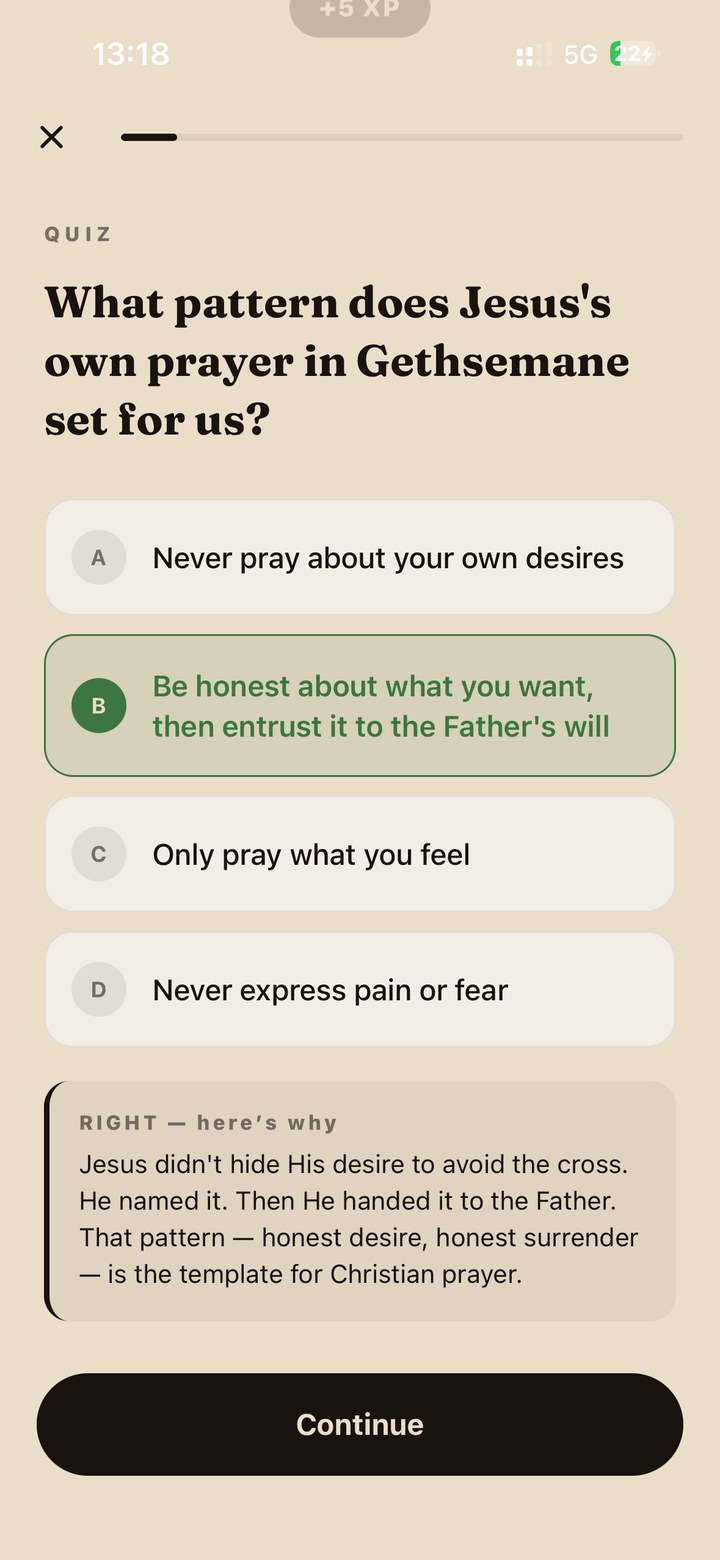
Saintly teaches in short illustrated lessons built like a magazine: a hero image, a passage of Scripture or the Catechism, a quotation, a moment for reflection and then a quiz. Courses run in order, from the foundations of the faith through the Mass, prayer, the saints and the seven sacraments. Every day the home screen adds a saint of the day, the day's reading and an evening examen, and an AI companion answers questions the lessons do not cover. Seven courses and the daily content are free. Saintly Plus unlocks the rest for $40 a year.
The honest difference is taste. Creedo has more lessons and stronger parish tools today. Saintly puts more weight on explaining the why behind each teaching, with sources, and accompanies the whole day from the morning reading to the evening examen. It is available in English and German. Both are young apps made by small teams, and both are improving quickly.
Can an AI chat app teach you the Catholic faith?
An AI app can answer your questions well, but it cannot replace a course. Truthly and Magisterium AI are the best-known Catholic AI apps. They are useful when you have a specific question, and much less useful when you do not yet know what to ask.
Truthly is a chat app that answers questions about Scripture and Church teaching, with a Bible mode, daily readings and short daily reflections. Its App Store listing offers a free trial before a monthly or annual subscription, and free access for clergy and for people who cannot afford it. Magisterium AI answers questions from a library of Church documents and shows the sources it used, which makes it popular with students, catechists and clergy.
The limit of any chat app is structure. A good teacher decides what you need to learn next, and a chat waits for you to ask. AI also makes mistakes, even when it is trained on Church documents, so a cited answer is worth more than a fluent one. Use these apps the way you would use a well-read friend: for questions, not for your whole formation.
How much do Catholic apps cost?
Most Catholic apps are free to download, with a paid subscription for the full experience. At US prices in October 2026, the annual plans range from about $40 to $70 a year. Every app in this guide offers some free content or a free trial.
- Hallow: $69.99 a year, family plan available, free trial.
- Ascension: core Bible and Catechism content free, subscription about $59.99 a year.
- Creedo: free lessons, Creedo Lux $49.99 a year or $6.99 a month, 7-day trial.
- Truthly: monthly or annual subscription after a free trial, free for clergy on request.
- Magisterium AI: free to use, with paid plans for heavier use.
- Saintly: seven courses and daily content free, Saintly Plus $40 a year, 7-day trial.
Prices vary by country and change during the year, so treat these as a guide and check the store before you subscribe.
Which Catholic app should you choose?
Choose by the job you need done. If you want to pray more, start with Hallow. If you want to read the whole Bible or Catechism, use Ascension. If you want to understand the faith step by step, use Creedo or Saintly. If you have questions, add an AI app.
A few situations make the choice easier:
- You are preparing for Confirmation or entering the Church. A lesson app gives you the structure a weekly class cannot. Pair it with your parish programme, not instead of it.
- You are coming back after years away. Start with short lessons on the basics and the sacraments, and read our guide to confession after years away before your first visit.
- You already know the faith and want to go deeper. Catechism in a Year or a study of the Church Fathers will stretch you more than any lesson app.
- You struggle to pray. Learning without prayer stays theoretical. Begin with something small, like the daily examen, and let an app support the habit.
Whichever app you choose, give it three weeks before you judge it. Habits take time, and the best app is the one you still open when the novelty has worn off.
Common questions
Is Hallow or Saintly better for learning the faith? +
They do different jobs. Hallow is built for prayer and meditation and teaches indirectly. Saintly is built to teach the faith in structured lessons with quizzes. If you want to understand what the Church believes and why, a lesson app fits better. If you want to pray more, Hallow fits better.
Is there a Duolingo for Catholics? +
Yes. Creedo and Saintly both teach the faith in short daily lessons with quizzes and streaks. Creedo follows the Duolingo format most closely, with points and a mascot. Saintly uses the same habit tools but builds each lesson more like a short illustrated magazine article.
Can I learn the Catholic faith with a free app? +
Yes. Ascension's Bible in a Year and Catechism in a Year content is free, Saintly's first seven courses are free, and Creedo and Hallow have free content too. A paid plan adds depth and convenience, but nobody needs to pay to learn the basics of the faith.
Are Catholic AI apps reliable? +
They are useful but not infallible. Apps trained on Church documents, such as Magisterium AI and Truthly, are far more reliable than a general chatbot on Catholic questions, but they can still be wrong. Prefer answers that cite the Catechism or Scripture, and check anything important with a priest.
Which Catholic app is best for OCIA or Confirmation preparation? +
A lesson app is the best companion to a parish programme, because it gives you short daily study between weekly sessions. Creedo offers tools for parishes running OCIA. Saintly's courses on the foundations of the faith and the sacraments follow the same ground at an individual pace.