What is the Feast of Christ the King?
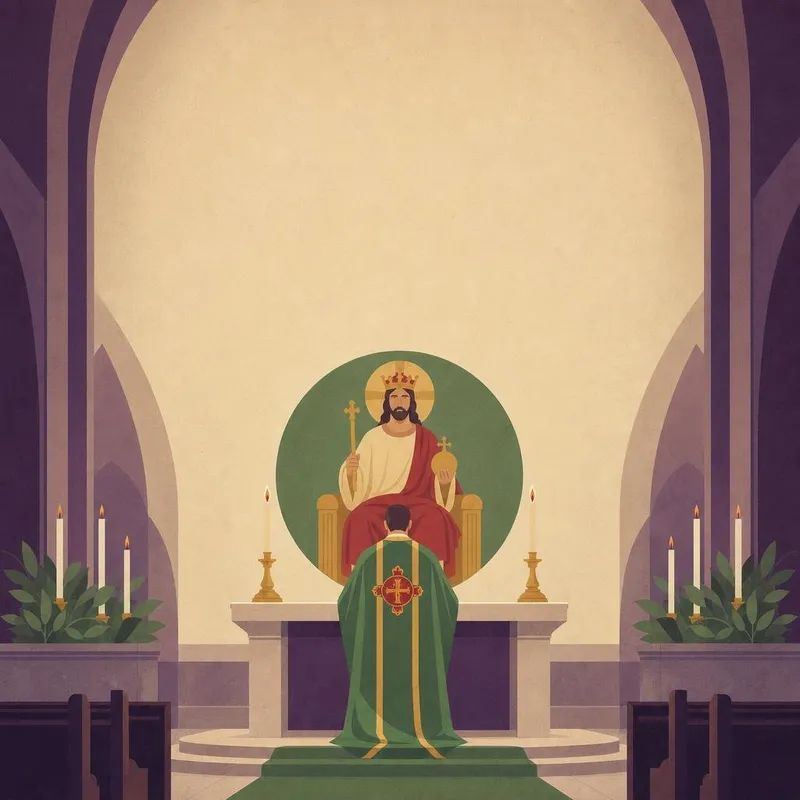
The Feast of Christ the King, officially the Solemnity of Our Lord Jesus Christ, King of the Universe, celebrates Christ's rule over all creation and history and closes the Church's year on the Sunday before Advent, which in 2026 is November 22. Pius XI created it in 1925 against a growing secularism, and the 1969 calendar moved it from late October to the last Sunday in Ordinary Time. Jesus is a king who serves and reigns from the Cross, and because the feast is a Sunday, Mass attendance is obligatory.
The Feast of Christ the King, officially the Solemnity of Our Lord Jesus Christ, King of the Universe, is the last Sunday of the Church's year. It celebrates one truth: that Jesus Christ is Lord of all creation and of all history, and that his reign will be complete when he returns in glory.
Pope Pius XI created it in 1925, and the Church moved it to its present place in 1969. In 2026 it falls on Sunday, November 22, one week before Advent begins.
What is the Feast of Christ the King?
It is a solemnity, the highest rank of feast, that honors Jesus Christ as king over every person, every nation and the whole created order. It closes the liturgical year by looking ahead to the end of time, when Christ will come again and his kingdom will be complete.
The Catechism states the belief behind the feast plainly: "Christ is Lord of the cosmos and of history" (CCC 668). It also names a tension that the feast holds together. Christ already reigns, but not yet fully: "Though already present in his Church, Christ's reign is nevertheless yet to be fulfilled 'with power and great glory' by the King's return to earth" (CCC 671).
That is why the feast sits where it does. The Church spends a year remembering the life of Christ, from his birth to his death, resurrection and ascension. On the last Sunday she looks forward to the end of the story: "Then the King will say to those at his right hand, 'Come, O blessed of my Father, inherit the kingdom prepared for you from the foundation of the world'" (Matthew 25:34).
When is the Feast of Christ the King in 2026?
In 2026 the Solemnity of Christ the King falls on Sunday, November 22. It is always the last Sunday in Ordinary Time, the Sunday before the First Sunday of Advent. Communities that use the 1962 Missal keep the older date, the last Sunday of October, which in 2026 is October 25.
The official calendar of the United States bishops lists November 22, 2026 as the solemnity of "Our Lord Jesus Christ, King of the Universe," with white vestments, and shows the new liturgical year beginning on November 29 (USCCB Liturgical Calendar 2026). That Sunday opens Advent.
Because Advent always begins on the fourth Sunday before Christmas, the date of Christ the King moves with it. It falls between November 20 and November 26.
The older date comes straight from Pius XI. He set the feast "on the last Sunday of the month of October - the Sunday, that is, which immediately precedes the Feast of All Saints" (Quas Primas 28). In that arrangement, the King is honored first, and then, on November 1, the saints who make up his kingdom. Our post on All Saints' Day and All Souls' Day covers the days that follow.
Why did Pius XI create the feast in 1925?
Pius XI instituted the feast in his encyclical Quas Primas, dated December 11, 1925, at the close of a Holy Year. Writing seven years after the First World War, he argued that the world's troubles came from pushing Christ out of public and private life, and that peace would come only under his rule.
He had made the same point in his first encyclical, and he repeated it at the start of Quas Primas. The world's "manifold evils," he wrote, were due to the fact that "the majority of men had thrust Jesus Christ and his holy law out of their lives." His conclusion was short: "Men must look for the peace of Christ in the Kingdom of Christ" (Quas Primas 1).
He named the problem he wanted the feast to answer. In the English translation, it is "the plague of anti-clericalism, its errors and impious activities" (Quas Primas 24). Today the word for it is usually secularism: the idea that God belongs in private life and has no claim on law, politics or culture.
His remedy was a feast rather than another document. People, he wrote, learn the faith "far more effectually by the annual celebration of our sacred mysteries than by any official pronouncement." Pronouncements "usually reach only a few and the more learned among the faithful; feasts reach them all" (Quas Primas 21).
Why did the feast move to the end of the liturgical year?
After the Second Vatican Council, the reformed Roman Calendar of 1969 moved the feast from late October to the last Sunday of the liturgical year and gave it its current title, "Our Lord Jesus Christ, King of the Universe." The new position ties Christ's kingship to his return at the end of time.
Pope Paul VI approved the new universal calendar in his motu proprio Mysterii Paschalis, dated February 14, 1969, and set it to "go into effect on January 1, 1970" (Mysterii Paschalis). Pope Benedict XVI summed up the change in one sentence: the solemnity "was established by Pius XI in 1925 and, later, after the Second Vatican Council, it was placed at the close of the liturgical year" (Angelus, 21 November 2010).
The move is less of a break than it looks. Pius XI had already picked late October because "it is at the end of the liturgical year," so that the feast "sets the crowning glory upon the mysteries of the life of Christ already commemorated during the year" (Quas Primas 29). The reform simply placed the feast at the true end of the year.
What kind of king is Jesus?
Jesus is a king who rules by serving and whose throne is the Cross. He told Pilate that his kingship is "not of this world." The Catechism teaches that the true meaning of his kingship is revealed only when he is lifted up on the Cross.
The decisive scene is his trial. Asked whether he is the King of the Jews, Jesus answers: "My kingship is not of this world; if my kingship were of this world, my servants would fight, that I might not be handed over to the Jews; but my kingship is not from the world." When Pilate presses him, he adds: "For this I was born, and for this I have come into the world, to bear witness to the truth. Every one who is of the truth hears my voice" (John 18:36 to 37).
The Catechism ties that kingship to the Cross: "Hence the true meaning of his kingship is revealed only when he is raised high on the cross" (CCC 440). The only crown Jesus wore was made of thorns, and his royal title was written as a charge and fixed to the Cross: "Jesus of Nazareth, the King of the Jews" (John 19:19).
It is also a kingship of service. "Christ, King and Lord of the universe, made himself the servant of all," the Catechism says, and for the Christian, "to reign is to serve him," above all in "the poor and the suffering" (CCC 786). Every baptized person shares in this: the whole People of God takes part in Christ's three offices of "priest, prophet, and king" (CCC 783).
Pius XI drew the personal consequence: "He must reign in our minds," "in our wills," "in our hearts" (Quas Primas 33).
Which Gospel is read on Christ the King?
The Gospel changes with the three-year cycle of Sunday readings. In Year A, which includes November 2026, it is the Last Judgment in Matthew 25:31 to 46. In Year B it is Jesus before Pilate in John 18:33b to 37, and in Year C it is the good thief on the cross in Luke 23:35 to 43.
The liturgical year that began on November 30, 2025 is Year A, and it ends on November 22, 2026. The readings for that day are Ezekiel 34, 1 Corinthians 15 and Matthew 25:31 to 46 (USCCB Liturgical Calendar 2026). In 2024, a Year B, the Gospel was John 18:33b to 37 (USCCB Liturgical Calendar 2024). In 2025, a Year C, it was Luke 23:35 to 43 (USCCB Liturgical Calendar 2025).
The three Gospels show one king from three angles. In Matthew he is the judge on the glorious throne. In John he is the prisoner who tells Pilate the truth. In Luke he is the crucified man who promises the good thief, "Truly, I say to you, today you will be with me in Paradise" (Luke 23:43).
The Year A Gospel is the most practical of the three. The King judges the nations by how they treated the hungry, the thirsty, the stranger, the naked, the sick and the imprisoned, and he says: "Truly, I say to you, as you did it to one of the least of these my brethren, you did it to me" (Matthew 25:40). The Catechism quotes the same verse and draws the lesson: "Our attitude to our neighbour will disclose acceptance or refusal of grace and divine love" (CCC 678).
The first reading in Year A, from Ezekiel, gives the same king a shepherd's face: "I myself will be the shepherd of my sheep" (Ezekiel 34:15).
How do Catholics celebrate Christ the King?
The center of the feast is Sunday Mass. Many parishes also pray the act of dedication of the human race to Jesus Christ the King, which carries a plenary indulgence when prayed publicly on the solemnity. Some add Eucharistic adoration or a procession with the Blessed Sacrament.
The act of dedication is older than the feast. Pius XI ordered that "the dedication of mankind to the Sacred Heart of Jesus," which Pius X had commanded to be renewed every year, "be made annually on that day" (Quas Primas 28). The prayer begins, in Latin, Iesu dulcissime, Redemptor humani generis: "Most sweet Jesus, Redeemer of the human race."
The Church's handbook of indulgences grants a plenary indulgence to the faithful who recite this act publicly on the Solemnity of Christ the King, and a partial indulgence in other circumstances (Enchiridion Indulgentiarum, concession 2). Our post on purgatory explains what an indulgence is.
Eucharistic adoration suits the day, because the King honored on the feast is the same Christ present in the Blessed Sacrament. Our post on the Eucharist explains the Real Presence.
At home, the feast is a natural moment to take stock before Advent: to read Matthew 25 slowly, to choose one of its works of mercy for the coming week, and to ask where Christ does not yet reign in your own mind, will and habits.
Is Christ the King a holy day of obligation?
Yes, because it always falls on a Sunday, and every Sunday is a day of obligation. Catholics fulfill it by attending Mass on the Sunday itself or on Saturday evening. No separate holy day rule is needed.
The Catechism gives the precept: "On Sundays and other holy days of obligation the faithful are bound to participate in the Mass," and adds that it is satisfied by Mass "either on the holy day or on the evening of the preceding day" (CCC 2180). Our post on holy days of obligation explains how these days work, and our guide on missing Sunday Mass covers what to do if you cannot go.
The feast also points to a duty that reaches beyond Mass. The Catechism teaches that the duty to worship God concerns people "both individually and socially." Christians "are called to be the light of the world. Thus, the Church shows forth the kingship of Christ over all creation and in particular over human societies" (CCC 2105). That is the feast's last word, and the Church's year ends on it.
Common questions
What color do priests wear on Christ the King? +
White. The official calendar lists white vestments for November 22, 2026 (USCCB Liturgical Calendar 2026). The following Sunday, the First Sunday of Advent, the color changes to violet.
Is Christ the King the last Sunday of the Church year? +
Yes. It is the last Sunday in Ordinary Time and of the liturgical year. The next Sunday is the First Sunday of Advent, which begins the new year: November 29, 2026, the start of Year B in the cycle of Sunday readings.
Why do some Catholics celebrate Christ the King in October? +
Pius XI placed the feast on the last Sunday of October, just before All Saints' Day (Quas Primas 28). Communities that use the 1962 Missal keep that date. In 2026 it falls on October 25.
Is Christ the King a political feast? +
Not in the sense of a party or a program. Pius XI wrote that Christ's kingdom "is spiritual and is concerned with spiritual things" (Quas Primas 15). The Church does teach that faith has a social side: Christians work "to infuse the Christian spirit into the mentality and mores, laws and structures" of their communities (CCC 2105).
Can I gain the indulgence if I pray the act of dedication at home? +
Praying the act privately gains a partial indulgence. The plenary indulgence is attached to reciting it publicly on the solemnity itself, under the usual conditions: confession, Communion and prayer for the Pope's intentions (Enchiridion Indulgentiarum, norm 20 and concession 2).