What is Advent?
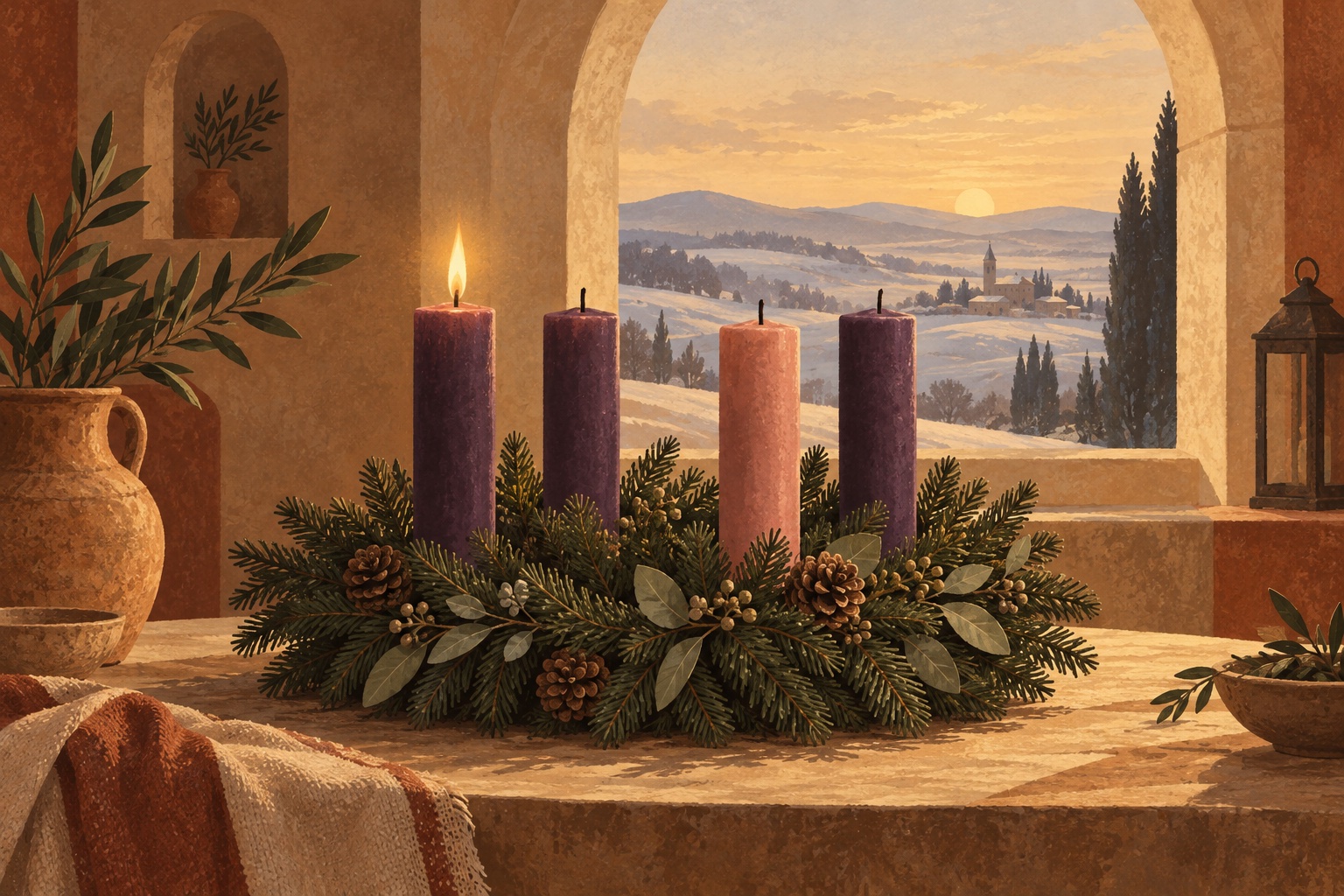
Advent is the season of about four weeks before Christmas in which the Church prepares both to celebrate Christ's birth and to await his return in glory. In 2026 it runs from Sunday, November 29, to the evening of December 24. It is a season of hopeful waiting, marked by violet, the Advent wreath and a quieter, more prayerful pace.
For most of the world, the weeks before Christmas are the busiest of the year. The Church asks for something close to the opposite: a slower, quieter season of waiting. That season is Advent, and it is the first part of the Church's year, not the last part of the calendar one.
This post explains what Advent is, when it falls in 2026, what its colours and customs mean, and a few simple ways to pray through it without adding another project to December.
What is Advent?
Advent is the liturgical season of about four weeks that prepares for Christmas. The word comes from the Latin adventus, meaning "coming." It begins the Church's liturgical year and looks toward two comings of Christ: his birth in Bethlehem and his return at the end of time.
The Catechism describes Advent as a way of entering the long hope of Israel: "When the Church celebrates the liturgy of Advent each year, she makes present this ancient expectancy of the Messiah, for by sharing in the long preparation for the Saviour's first coming, the faithful renew their ardent desire for his second coming" (CCC 524).
In practice, Advent shapes everything at Mass for four Sundays: the readings, the colour of the vestments, the music and even what is left out. It is the Church's way of teaching that Christmas is worth preparing for, and that waiting is itself a form of prayer.
When does Advent start and end in 2026?
In 2026, Advent begins on Sunday, November 29, and ends on the evening of Thursday, December 24, when the Christmas season begins with the vigil Mass. Because Christmas falls on a Friday, Advent 2026 has its full four Sundays and nearly four complete weeks.
The rule behind the date is simple. The First Sunday of Advent is always the fourth Sunday before Christmas Day. That means it can fall anywhere from November 27 to December 3, and Advent can last from just over three weeks to a full four.
The four Sundays of Advent 2026 are:
- First Sunday of Advent: November 29
- Second Sunday of Advent: December 6
- Third Sunday of Advent (Gaudete Sunday): December 13
- Fourth Sunday of Advent: December 20
The Solemnity of the Immaculate Conception on December 8 also falls within Advent. In many countries it is a holy day of obligation, so check your own diocese. Advent 2026 also opens a new cycle of Sunday readings, Year B, in which most Sunday Gospels come from Mark.
Why does Advent look to two comings of Christ?
Because the Church does not only remember the past. The first half of Advent, until December 16, focuses mainly on Christ's second coming at the end of time. From December 17, the focus turns to the events just before his birth in Bethlehem.
This is why the first Sunday's Gospel is not about shepherds or angels but about watchfulness and the end of the world. The message is that the same Lord who came quietly at Bethlehem will come again in glory, and that the right way to prepare for both is to stay awake. As Jesus puts it, "Watch therefore, for you do not know on what day your Lord is coming" (Matthew 24:42).
John the Baptist is the other great Advent figure. The Catechism notes that "by celebrating the precursor's birth and martyrdom, the Church unites herself to his desire: 'He must increase, but I must decrease'" (CCC 524). His call to prepare the way of the Lord is heard on the second and third Sundays.
The third great figure is Mary. The Fourth Sunday of Advent brings her to the centre, and its Gospel is the Annunciation or the Visitation. In 2026 it is the Annunciation. Her answer to the angel is the model of Advent waiting: not passive, but ready and willing. "Behold, I am the handmaid of the Lord; let it be to me according to your word" (Luke 1:38). Advent asks the same readiness of every Christian, in small daily choices rather than dramatic gestures.
Why is Advent violet, with one rose Sunday?
Violet is the colour of preparation and penance, the same colour used in Lent. On the Third Sunday of Advent, called Gaudete Sunday, the Church may use rose instead, a lighter colour that signals joy because Christmas is near.
Gaudete is Latin for "rejoice," the first word of the traditional entrance antiphon for that Sunday, taken from St. Paul: "Rejoice in the Lord always; again I will say, Rejoice" (Philippians 4:4). The rose colour is a short pause in the season's restraint, a reminder that the waiting has an end.
The restraint shows elsewhere too. On the Sundays of Advent the Gloria is not sung at Mass, so that it can return with full force on Christmas night, when the Church repeats the angels' song. Churches are often decorated more simply, and many parishes hold back Christmas music until December 24.
How does the Advent wreath work?
An Advent wreath is a circle of evergreen branches holding four candles, usually three violet and one rose. One candle is lit on the First Sunday of Advent, a second is added each following week, and the rose candle is lit on Gaudete Sunday.
The wreath is a domestic custom rather than a required part of the liturgy, but the Church has a blessing for it and many parishes use one in the sanctuary. The evergreen suggests life that does not die; the growing light suggests Christ, the light of the world, drawing closer each week.
At home, a simple practice works well. Gather once a day, often at the evening meal, light the candles for the current week, read a short passage from the Sunday Gospel or from Isaiah, pray an Our Father and a Hail Mary, and blow the candles out. It takes five minutes and gives the whole season a shape children remember for life. If evenings are chaotic, light it at breakfast instead; the timing matters less than the habit.
What are the O Antiphons?
The O Antiphons are seven short prayers sung before the Magnificat at Evening Prayer from December 17 to 23. Each addresses Christ with an Old Testament title and ends with a plea: come. They are also the source of the hymn "O Come, O Come, Emmanuel."
The seven titles, in order, are: O Wisdom, O Lord of Israel, O Root of Jesse, O Key of David, O Dayspring, O King of the Nations, and O Emmanuel. Each draws on the prophecies of Isaiah, and together they compress the whole hope of the Old Testament into a single week. The last, Emmanuel, means "God with us," the name Isaiah gives the child to be born of a virgin (Isaiah 7:14).
You do not need to pray the Liturgy of the Hours to use them. Reading one antiphon each evening from December 17, perhaps at the Advent wreath, is a simple way to mark the final stretch before Christmas.
Is Advent a penitential season like Lent?
Partly. Advent shares Lent's violet and some of its restraint, and it is a traditional time for confession. But its main note is hopeful expectation rather than penance. There is no obligatory fasting in Advent, and the mood is closer to joyful preparation than to mourning.
The Catechism links the two seasons as privileged times for Scripture: "especially during Advent and Lent and above all at the Easter Vigil," the Church "re-reads and re-lives the great events of salvation history" (CCC 1095). Advent reads the prophets; Lent reads the road to the cross.
Many parishes hold a penance service in Advent, and going to confession before Christmas is one of the most practical ways to keep the season. If it has been a while, start with an examination of conscience, and bring the Act of Contrition with you.
How can you pray through Advent?
Choose one or two small daily practices and keep them for the whole four weeks. A short daily prayer kept faithfully does more than an ambitious plan abandoned by the second week. Advent rewards consistency, not intensity.
Some practices that suit the season:
- Read the daily Mass readings each morning. Advent's first readings are mostly from Isaiah, the great prophet of the season.
- Pray the Angelus at noon. It is a prayer about the Incarnation, which makes it the natural daily prayer of Advent.
- Pray the Joyful Mysteries of the Rosary: the Annunciation, the Visitation, the Nativity, the Presentation and the Finding in the Temple.
- End each day with the daily examen, asking where you were watchful and where you drifted.
- Go to confession once before Christmas, ideally in the first two weeks, before parishes get busy.
The aim is not to make December harder. It is to make room. Advent is a season of waiting for someone, and the simplest way to keep it is to leave a little quiet each day where that someone can arrive.
Common questions
How long is Advent? +
Between three and four weeks. Advent always contains four Sundays and begins on the fourth Sunday before Christmas, so its length depends on which weekday Christmas falls. In 2026 it runs from November 29 to December 24.
Is Advent part of the Christmas season? +
No. Advent is the season of preparation before Christmas. The Christmas season begins on the evening of December 24 and continues until the Baptism of the Lord in January.
What do the four Advent candles mean? +
The candles mark the four weeks of waiting, with more light each Sunday as Christmas approaches. Popular devotions give each candle a meaning such as hope, peace, joy and love, but these names are a custom, not an official teaching.
Do Catholics fast during Advent? +
There is no required fast in Advent. Many Catholics choose a small voluntary sacrifice as part of their preparation, but the season is marked more by prayer and expectation than by penance.
When is Gaudete Sunday in 2026? +
Gaudete Sunday, the Third Sunday of Advent, falls on December 13, 2026. Priests may wear rose vestments, and the rose candle on the Advent wreath is lit.