Saintly vs Laudate: which Catholic app do you need?
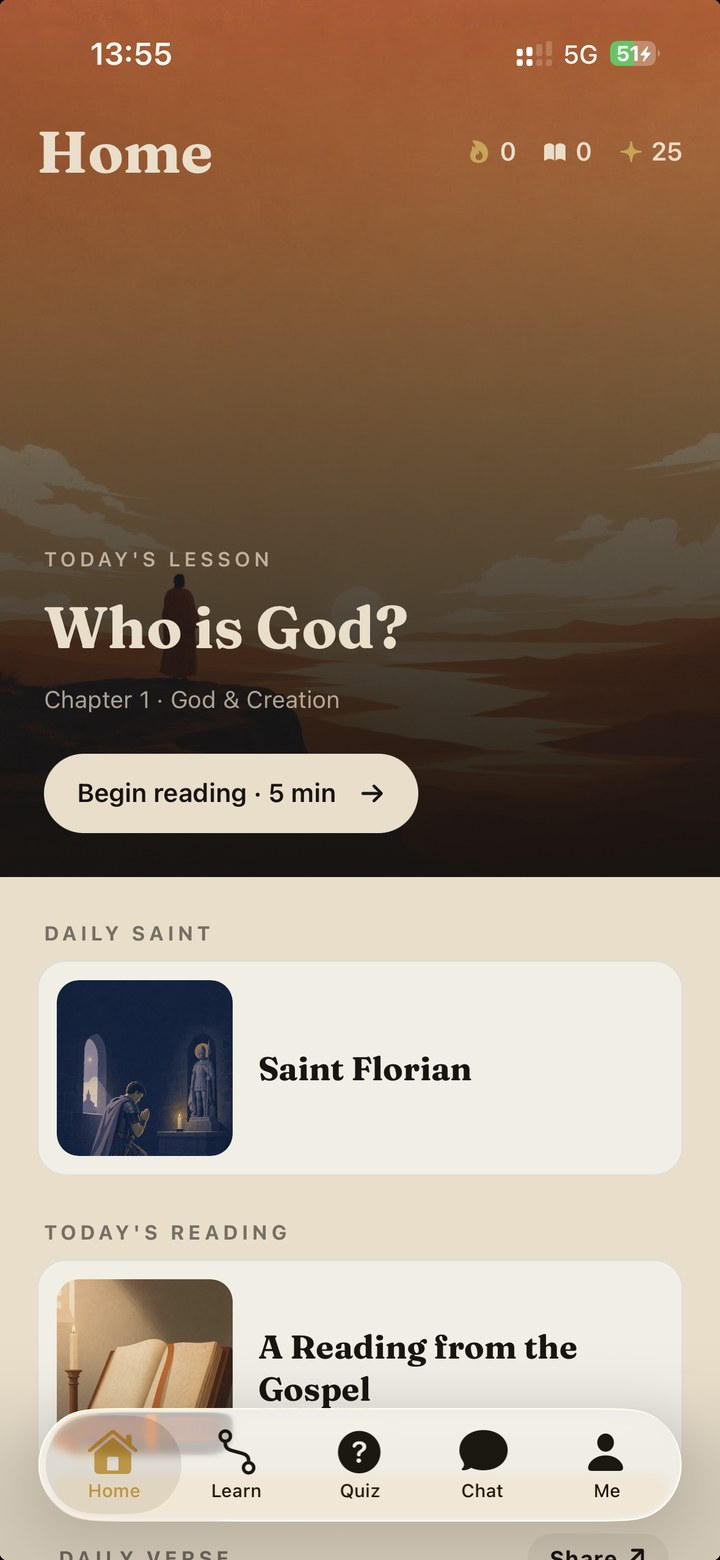
Laudate is a free Catholic reference app: Mass readings, the Liturgy of the Hours, many Rosaries and prayers, the Bible and the Catechism in one place. Saintly is a learning app: short illustrated courses that explain the faith and check your understanding, with a daily saint and an AI companion. Use Laudate to find texts, Saintly to understand them. Many Catholics keep both.
Laudate and Saintly answer different needs. Laudate is a library: almost every text a Catholic might want on a phone, free and in many languages. Saintly is a teacher: it takes you through the faith in order, a few minutes a day, and checks that you understood.
Saintly publishes this comparison, and Saintly is one of the apps in it. We have described Laudate as fairly as its own makers would, linked to their own pages for prices and features, and said plainly where Laudate is the better choice. Prices are US prices checked on October 20, 2026. They vary by country and change, so check the store before you subscribe.
What is the difference between Saintly and Laudate?
Laudate gives you the texts. Saintly explains them. Laudate collects the Mass readings, the Liturgy of the Hours, prayers, the Bible and the Catechism so you can find and pray them. Saintly teaches what those texts mean in short courses, with quizzes, a daily saint and an AI companion.
A useful test is what you open the app for. If you open it to pray Lauds, read today's Gospel or find the words of a chaplet, you need Laudate. If you open it to learn why the Church prays the hours, what the Gospel passage means or how a sacrament works, you need a learning app.
Both needs belong to the same faith. The Catechism says the mystery of faith asks to be believed, celebrated and lived, and that this living relationship with God "is prayer" (CCC 2558). Laudate serves the praying; Saintly serves the believing with understanding.
What does Laudate do best?
Laudate does breadth best, and it does it for free. Its App Store listing lists daily Mass readings with the saint of the day, the Liturgy of the Hours in English and Latin, the Latin Mass, an interactive Rosary and the Divine Mercy Chaplet, the Stations of the Cross, the Bible, the Catechism, confession guides and Vatican documents.
It is the closest thing to a complete Catholic prayer book in an app. Several Rosaries and chaplets, searchable prayers with Latin text, a Douay-Rheims Bible for offline use, podcasts and a daily Mass live stream sit side by side. The app is available in English and eighteen other languages.
Laudate is free, and its App Store privacy label says the developer collects no data from the app. For a parish volunteer, a seminarian or anyone who prays the Liturgy of the Hours, that combination is hard to beat.
Its limit is that it does not teach. It hands you the texts and leaves the understanding to you. It is also dense: with so much in one place, beginners can find it hard to know where to start, and its design is functional rather than inviting.
What does Saintly do best?
Saintly does explanation and guidance best. Its sixteen courses run from the foundations of the faith through the Mass, prayer, the saints, the Bible and the seven sacraments. Each lesson takes about five minutes, cites the Catechism or Scripture, and ends with a quiz.
Lessons are built like short illustrated magazine articles and can be read aloud. A practice quiz brings back what you got wrong before. The home screen adds the saint of the day as a short illustrated story, the day's Mass readings, a daily quote and an evening examen.
When a lesson raises a question, an AI companion answers it with sources and points you to a priest when a question belongs in confession or spiritual direction. That turns the app into a place to ask the questions a reference app cannot answer.
Saintly is not a complete prayer book. It has the Rosary, guided prayers and Sleep Scriptures, but not the Liturgy of the Hours, the Latin Mass or the range of chaplets Laudate offers. It is available in English and German only.
How do Saintly and Laudate compare feature by feature?
Laudate is wider and free, Saintly is guided and teaches. Both run on iPhone and Android. The table shows where each one is stronger.
| Laudate | Saintly | |
|---|---|---|
| Built for | Finding and praying Catholic texts | Understanding the faith |
| Mass readings | Yes | Yes |
| Liturgy of the Hours | Yes, English and Latin | No |
| Rosary and chaplets | Many, interactive | Rosary with audio |
| Structured courses | No | 16 courses with quizzes |
| Saint of the day | Yes, short entry | Yes, illustrated story |
| Questions answered | No | AI companion with sources |
| Languages | English and 18 more | English and German |
| Price | Free | Free tier, Plus $40 a year |
How much do Saintly and Laudate cost?
Laudate is free, with no subscription listed in the App Store. Saintly is free to download, and Saintly Plus costs $40 a year in the US with a seven-day free trial.
Saintly's free tier includes seven of sixteen courses, the daily saint, the day's Mass readings, the evening examen, the Rosary, guided prayer audio, a Bible reader and three questions a day to the AI companion. Plus adds the remaining nine courses, unlimited Bible and Discover cards, Sleep Scriptures, widgets and up to a hundred questions a day to the AI companion.
Because Laudate is free and Saintly's free tier is substantial, you can use both without paying anything and decide later whether the extra courses are worth it to you.
Which one should you choose?
Choose Laudate if you already pray regularly and need the texts. Choose Saintly if you want to understand the faith before, or alongside, praying it. Most people who are new to the faith or returning to it need understanding first, and most people who pray the hours daily need Laudate.
A few situations make it clearer:
- You pray the Liturgy of the Hours. Laudate, without question.
- You are in OCIA or preparing for Confirmation. Saintly's courses give you structured daily study that a reference app does not.
- You are returning after years away. Start with lessons on the basics and our guide to confession after years away, then use Laudate for the prayers you rediscover.
- You want one app for the whole day. Saintly's daily saint, readings and evening examen cover the day; Laudate covers the prayers in between.
Can you use Saintly and Laudate together?
Yes, and they complement each other well. Laudate holds the texts; Saintly explains them. A lesson on the Mass in Saintly makes the readings in Laudate easier to follow, and a lesson on the Rosary makes Laudate's interactive Rosary more meaningful.
For other comparisons, read Saintly vs Hallow for prayer apps, or our guide to the best Catholic apps to learn the faith for a wider overview.
The test for any app is the same: does it help you pray, and does it help you understand? Most Catholics need a little of both.
Common questions
Is Laudate free? +
Yes. Laudate is free to download and its App Store listing shows no subscription. It includes Mass readings, the Liturgy of the Hours, many Rosaries and chaplets, the Bible, the Catechism and a daily Mass live stream.
Is Laudate good for learning the faith? +
Laudate is a reference and prayer app. It gives you the texts, including the Catechism, but does not teach them in structured lessons or check what you understood. A learning app such as Saintly is better for that.
Does Saintly have the Liturgy of the Hours? +
No. Saintly has the Mass readings, the Rosary, guided prayers, an evening examen and Sleep Scriptures, but not the Liturgy of the Hours. Laudate offers the hours in English and Latin.
Which app has the saint of the day? +
Both. Laudate shows a short saint of the day entry with the readings. Saintly tells the saint's life as a two-minute illustrated story with small actions you can take that day.
Can I use Saintly and Laudate together? +
Yes. Many Catholics use Laudate for daily prayer texts and Saintly to understand the faith behind them. Both have free versions, so you can use both without paying.