Who is Our Lady of Guadalupe?
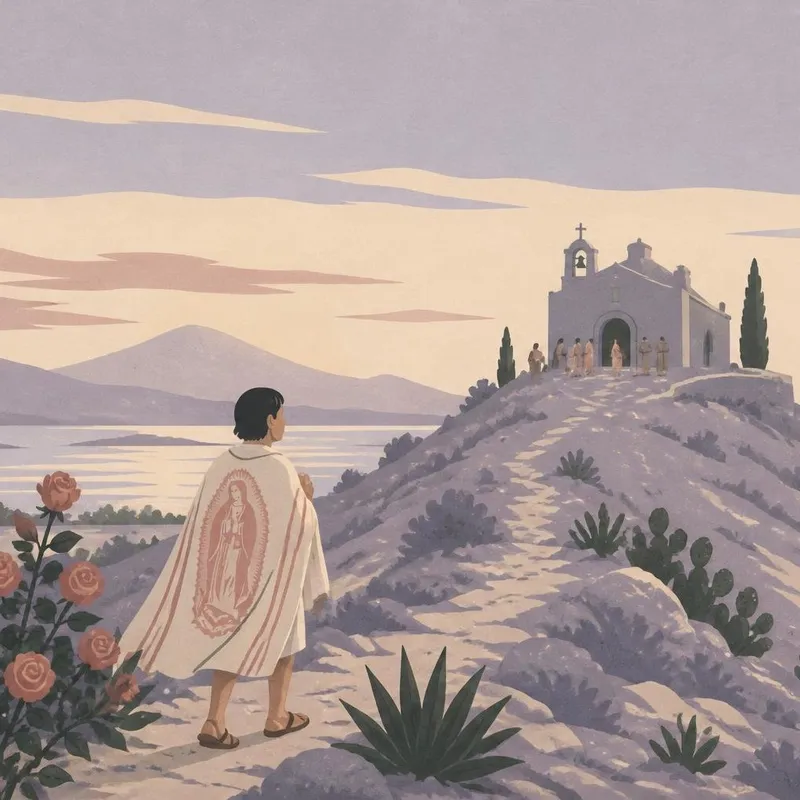
Our Lady of Guadalupe is the Virgin Mary as she appeared to Saint Juan Diego on Tepeyac hill near Mexico City from December 9 to 12, 1531, leaving her image on his cloak as a sign for the bishop. The Church honors her as patroness of the Americas and keeps her feast on December 12.
Our Lady of Guadalupe is the Virgin Mary as she appeared in December 1531 to Juan Diego, a baptized Aztec man, on the hill of Tepeyac outside what is now Mexico City. Her image, left on his cloak, hangs today in the Basilica of Guadalupe, and her feast falls on December 12.
She is the best-known Marian title in the Americas and one of the most visited shrines in the world. This post tells what happened at Tepeyac, what the image shows, who Juan Diego was, how much of the story a Catholic is bound to believe, and how the Church keeps the feast.
Who is Our Lady of Guadalupe?
Our Lady of Guadalupe is Mary, the mother of Jesus, under the title she received after appearing to Saint Juan Diego in Mexico in 1531. She is not a second Mary or a local goddess. The Church honors her as the patroness of the Americas and keeps her feast on December 12.
According to the oldest account, she introduced herself as the "ever perfect Holy Virgin Mary, Mother of the true God." Pope Francis quoted those words from the Nican Mopohua in his homily for the feast in 2014 (Homily, 12 December 2014).
John Paul II summed up her place in one sentence: "not only in Central and South America, but in North America as well, the Virgin of Guadalupe is venerated as Queen of all America" (Ecclesia in America, 11). He wrote that in 1999, after a synod of bishops from the whole continent. It explains why her image appears in parishes from Chicago to Buenos Aires, and why so many girls are named Guadalupe or Lupita.
What happened at Tepeyac in 1531?
On December 9, 1531, Mary appeared to Juan Diego on Tepeyac hill and asked him to tell the bishop to build a shrine there. The bishop asked for a sign. On December 12 she sent Juan Diego to gather roses blooming in winter, and when he opened his cloak before the bishop, her image was on it.
The Vatican's own biography of the saint tells the story plainly. Juan Diego was on his way to morning Mass when the Blessed Mother appeared to him. She asked that a shrine be built at Tepeyac, "where she promised to pour out her grace upon those who invoked her" (Juan Diego Cuauhtlatoatzin: biography). The bishop did not believe him and asked for proof.
Three days later Juan Diego returned. Mary told him to climb the hill and pick the flowers he would find there. "Although it was winter time, he found roses flowering." She arranged them in his cloak and sent him back to the bishop. "When he opened his mantle, the flowers fell on the ground and there remained impressed, in place of the flowers, an image of the Blessed Mother" (Juan Diego Cuauhtlatoatzin: biography).
The main source for these events is the Nican Mopohua, which the same biography calls "the most important and oldest indigenous document on the event of Guadalupe." It was written in Nahuatl, the Aztec language, by the indigenous writer Antonio Valeriano around 1556. Its tenderness is what most readers remember. When Pope Francis visited the shrine in 2016 he quoted two of Mary's questions from it: "What, my most precious little one, saddens your heart?" and "Yet am I not here with you, who have the honour of being your mother?" (Homily, 13 February 2016).
The timing was not incidental. Mexico had fallen to the Spanish only ten years earlier. The conquered peoples had every reason to distrust a faith brought by their conquerors. Mary came to one of them, spoke his language and dressed like his people. Francis described it this way: "she walked through Tepeyac, wearing the indigenous garb and using their language" (Homily, 13 February 2016). The Mexican bishops later wrote that the event "meant the beginning of evangelization with a vitality that surpassed all expectations," a line John Paul II quoted when he canonized Juan Diego (Homily, 31 July 2002).
What does the image on the tilma show?
The image shows a young woman with native features, standing on the moon, in a blue mantle covered with gold stars, her hands joined in prayer. A black sash at her waist marks her as pregnant. An angel supports her from below. It is a portrait of Mary carrying Christ to a new people.
Each detail would have spoken to an Aztec viewer, and the Vatican biography reads them one by one. The image "shows a woman with native features and dress." She "is supported by an angel whose wings are reminiscent of one of the major gods of the traditional religion of that area. The moon is beneath her feet and her blue mantle is covered with gold stars. The black girdle about her waist signifies that she is pregnant" (Juan Diego Cuauhtlatoatzin: biography).
The woman is greater than the sun and moon the Aztecs worshiped, yet she prays to someone greater than herself. Christians reading the image also hear the Book of Revelation: "a great portent appeared in heaven, a woman clothed with the sun, with the moon under her feet, and on her head a crown of twelve stars" (Revelation 12:1). Pope Francis drew the same connection in 2014 and added that she took "upon herself the cultural and religious symbolism of the indigenous peoples" to give them her Son (Homily, 12 December 2014).
The cloak itself is a tilma, a simple outer garment of plant fibre. It hangs above the main altar of the Basilica of Our Lady of Guadalupe in Mexico City, which John Paul II called "the Marian heart of Mexico and of America" (Homily, 31 July 2002).
Catholics who pray before it are not worshiping cloth and paint. The Catechism teaches that "the honor rendered to an image passes to its prototype" (CCC 2132), and that through sacred images of the Mother of God "we venerate the persons represented" (CCC 1192). The honor goes to Mary, and through her to God.
Who was Saint Juan Diego?
Juan Diego was a layman of the Chichimeca people, born in 1474 with the name Cuauhtlatoatzin, "the talking eagle." He was baptized around the age of fifty, saw Mary at Tepeyac, then spent his last years as a hermit beside her chapel. He died in 1548 and was canonized in 2002.
After the apparitions, he asked the bishop's permission to live in a small hut near the chapel where the image was placed. There "he cared for the church and the first pilgrims who came to pray to the Mother of Jesus" (Juan Diego Cuauhtlatoatzin: biography). John Paul II beatified him on May 6, 1990, at the basilica, and returned to canonize him on July 31, 2002, as "the first indigenous Saint of the American Continent" (Homily, 31 July 2002). Our post on how someone becomes a saint explains those two steps.
What the Church sees in him is humility. In the Nican Mopohua he calls himself a "leather strap, a back frame, a tail, a wing, oppressed by another's burden," yet Mary makes him "the ambassador, most worthy of trust" (as quoted by Pope Francis, Homily, 13 February 2016). At the canonization John Paul II chose the Gospel in which Jesus thanks the Father for hiding these things "from the wise and understanding" and revealing them "to babes" (Matthew 11:25, as quoted in the Homily, 31 July 2002). Juan Diego's memorial is kept on December 9, the date of the first apparition (USCCB Liturgical Calendar 2026).
Do Catholics have to believe in Guadalupe?
No. Guadalupe is a private revelation. The Church has approved the devotion, built a basilica, put the feast in its calendar and canonized the visionary, but private revelations are not part of the deposit of faith. A Catholic may doubt the details and remain in good standing.
The Catechism draws the line clearly. Private revelations, even approved ones, "do not belong, however, to the deposit of faith. It is not their role to improve or complete Christ's definitive Revelation, but to help live more fully by it in a certain period of history" (CCC 67). What a Catholic must believe about Mary is what Scripture and the Creed say: that she is the Mother of God, ever virgin, conceived without sin and assumed into heaven. Our post on the Immaculate Conception, whose solemnity comes four days before Guadalupe, explains one of those dogmas.
In practice, though, the Church has given Guadalupe about as much approval as any apparition can receive. The message also fits the faith exactly. Mary asks for a church, calls herself the Mother of the true God and points to her Son. That is the test the Catechism sets when it says the faithful know how "to discern and welcome in these revelations whatever constitutes an authentic call of Christ or his saints to the Church" (CCC 67).
Why is she called the Mother of the Americas?
Because the Church in the whole continent has taken her as its patroness. In 1999 John Paul II accepted the bishops' proposal that her feast be kept across the Americas on December 12, and he greeted her as "Mother of America." The title reflects how she brought the Gospel to a continent in a form its peoples could recognize.
In Ecclesia in America he wrote that "the appearance of Mary to the native Juan Diego on the hill of Tepeyac in 1531 had a decisive effect on evangelization." The peoples of the continent recognized "in the mestiza face of the Virgin of Tepeyac, 'in Blessed Mary of Guadalupe, an impressive example of a perfectly inculturated evangelization'" (Ecclesia in America, 11). He welcomed "the proposal of the Synod Fathers that the feast of Our Lady of Guadalupe, Mother and Evangelizer of America, be celebrated throughout the continent on December 12" (same paragraph).
Mestiza means of mixed descent, and Pope Francis returned to the word often. In 2019 he said that "she chose to appear as a mestiza in order to be the Mother of all" (Homily, 12 December 2019). He also warned against pulling her into politics: "The message of Guadalupe does not tolerate ideologies of any kind" (Homily, 12 December 2023).
How do Catholics celebrate December 12?
They go to Mass, often before dawn, sing Las Mañanitas to the Virgin, bring roses to her image and, where they can, make a pilgrimage to a shrine. In Mexico City millions walk to the basilica in the days around the feast. Many families prepare with a novena that begins on December 3.
In the United States, December 12 is a feast on the national calendar, with its own readings, including the woman clothed with the sun from Revelation 12 (USCCB Liturgical Calendar 2026). In 2026 it falls on a Saturday in the second week of Advent, a season of waiting that suits a feast of the pregnant Virgin. Our post on Advent explains how the two fit together.
You can keep the day without a trip to Mexico. Go to Mass if your parish has one in her honor. Bring flowers to an image of Mary at church or at home. Pray a novena from December 3, or the Rosary, which the Catechism calls an "epitome of the whole Gospel" (CCC 971). And when you are worried, take her question as addressed to you: "Am I not here, I, who am your Mother?" (Homily, 12 December 2014).
None of this is worship of Mary. The Catechism places devotion to her inside the worship of God: it "differs essentially from the adoration which is given to the incarnate Word and equally to the Father and the Holy Spirit, and greatly fosters this adoration" (CCC 971). Mary, it says elsewhere, "shows the way" (CCC 2674). Our post Do Catholics worship Mary? goes into the difference. The Virgin of Tepeyac is the clearest picture of it: a woman with her hands folded, carrying a child who is not yet visible, sending a poor man to the bishop to ask for a church.
Common questions
When is the feast of Our Lady of Guadalupe? +
December 12. It is a feast in the United States and across the Americas, and the principal feast of the year in Mexico. In 2026 it falls on Saturday, December 12. The memorial of Saint Juan Diego is three days earlier, on December 9 (USCCB Liturgical Calendar 2026).
Is December 12 a holy day of obligation? +
Not in the United States. The USCCB calendar ranks it as a feast, not a holy day (USCCB Liturgical Calendar 2026). The nearby holy day is the Immaculate Conception on December 8. Catholics in other countries should check their own bishops' conference.
What did Our Lady say to Juan Diego? +
She asked him to have the bishop build a shrine at Tepeyac, where she promised to pour out her grace on all who invoked her. Her best-known words, as Pope Francis quoted them from the Nican Mopohua, are: "Why are you afraid? Am I not here, I, who am your Mother?"
Where is the tilma today? +
In the Basilica of Our Lady of Guadalupe at the foot of Tepeyac hill in Mexico City. It hangs above the main altar. John Paul II called the basilica "the Marian heart of Mexico and of America."
Is Our Lady of Guadalupe the same Mary as in the Bible? +
Yes. Guadalupe is a title, not a different person. It names the Mary of the Gospels, who said: "henceforth all generations will call me blessed" (Luke 1:48). Lourdes, Fatima and Guadalupe are places where the one Mother of Jesus was honored.