Do Catholics worship Mary?
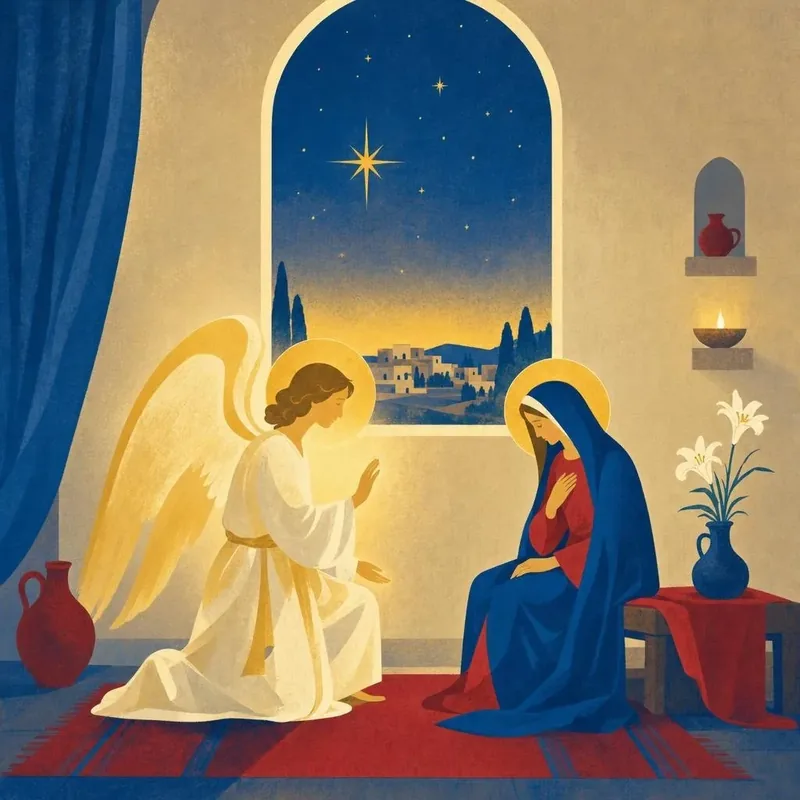
No: Catholics adore God alone, and they honor Mary with a devotion the Church calls veneration, which the Catechism says "differs essentially" from the adoration given to God. Praying to Mary means asking her to pray for us, the way you would ask a friend. The Church teaches that every honor given to her should lead people to her son.
Catholics adore God alone. Mary receives a different kind of honor, which the Church calls veneration, because God chose her to be the mother of his Son.
The question is still a fair one. Catholics pray to Mary and kneel before her statues. From a church tradition without these practices, that can look a lot like worship. This post explains where the Church draws that line, and how it answers the objections Protestants raise most often.
What is the difference between worshiping God and honoring Mary?
Worship in the full sense, which the Church calls adoration, means acknowledging someone as God: the Creator and Savior, Lord of everything that exists. Catholics give this to God alone. The honor given to Mary is love and respect for a creature God chose, and the Church treats the two as different in kind.
The Catechism explains: "To adore God is to acknowledge him as God, as the Creator and Savior, the Lord and Master of everything that exists" (CCC 2096). It also means acknowledging the "nothingness of the creature" before God, and the Catechism names Mary as the model: to adore God is to humble oneself "as Mary did in the Magnificat" (CCC 2097).
On devotion to Mary itself, the Catechism quotes the Second Vatican Council. This devotion "differs essentially from the adoration which is given to the incarnate Word and equally to the Father and the Holy Spirit, and greatly fosters this adoration" (CCC 971). The key word is essentially. Marian devotion belongs to a different category from the worship of God, and the Church expects it to feed that worship.
Some of the confusion is vocabulary. The Vatican's English text of the council calls Marian devotion a "special cult," from the Latin cultus, meaning devotion, and a few lines later says it "differs essentially from the cult of adoration" (Lumen Gentium 66).
What do latria, dulia and hyperdulia mean?
Latria, dulia and hyperdulia are the traditional names for degrees of religious honor. Latria is adoration, owed to God alone. Dulia is honor given to a creature for an excellence that comes from God, as with the saints. Hyperdulia is the highest form of dulia, given to Mary because she is the Mother of God.
St. Thomas Aquinas gave the classic explanation. He notes that dulia is Greek for servitude, and he calls it "a distinct virtue from latria, which pays due service to the lordship of God" (Summa Theologiae II-II, q.103, a.3). God alone is Creator, so the honor owed to him is unique.
On Mary he is specific. He calls her "a mere rational creature," owed dulia "in a higher degree than to other creatures, inasmuch as she is the Mother of God" (Summa Theologiae III, q.25, a.5). He names that higher degree elsewhere: "Hyperdulia is the highest species of dulia taken in a wide sense" (II-II, q.103, a.4).
The scale matters more than the Greek. Hyperdulia sits at the top of the honor a creature can receive, and the gap between it and latria is the gap between creature and Creator.
Why do Catholics honor Mary at all?
Catholics honor Mary because God honored her first. Scripture records an angel greeting her as "full of grace," and Mary herself predicting that "all generations will call me blessed." Catholic devotion takes those words at face value. The deeper reason is her son: Mary is the mother of Jesus, and Jesus is God.
Gabriel greets her: "Hail, full of grace, the Lord is with you" (Luke 1:28). Elizabeth, "filled with the Holy Spirit," cries out, "Blessed are you among women, and blessed is the fruit of your womb," and calls her "the mother of my Lord" (Luke 1:41-43). In the Magnificat, Mary says, "henceforth all generations will call me blessed" (Luke 1:48).
From the cross, Jesus entrusts his mother to the beloved disciple: "Woman, behold, your son," and "from that hour the disciple took her to his own home" (John 19:26-27). The Catechism applies the scene to every believer: "Like the beloved disciple we welcome Jesus' mother into our homes" (CCC 2679).
The title Catholics use most is Mother of God. The Council of Ephesus proclaimed it in 431 against the view that Christ was a human person joined to the divine Son (CCC 466). The child Mary bore is one divine person, so she is truly "Mother of God," in Greek Theotokos (CCC 495). In the Catechism's words, "What the Catholic faith believes about Mary is based on what it believes about Christ" (CCC 487).
A good deal of Marian prayer replays these scenes. The Angelus, prayed three times a day, walks through the Annunciation. The belief that Mary was kept free of original sin from her conception has its own post, what the Immaculate Conception is, and the Catechism stresses that this grace "comes wholly from Christ" (CCC 492).
What does it mean to pray to Mary?
Praying to Mary means asking her to pray for us. In the Hail Mary, the request at the center is "pray for us sinners, now and at the hour of our death." Christians do the same when they ask a friend for prayer. Catholics address the request to someone who is already with God.
The Hail Mary is mostly Scripture. Its first half joins Gabriel's greeting to Elizabeth's, and the Catechism walks through it line by line (CCC 2676). Of the second half it says: "By asking Mary to pray for us, we acknowledge ourselves to be poor sinners" (CCC 2677).
The New Testament takes for granted that Christians pray for one another: "The prayer of a righteous man has great power in its effects" (James 5:16). Catholics believe death in Christ leaves that bond in place. The saints "do not cease to intercede with the Father for us" (CCC 956), and the Catechism concludes: "We can and should ask them to intercede for us and for the whole world" (CCC 2683).
Mary is the saint Catholics ask most often, and the same reasoning applies to every saint, which is why many Catholics also choose a patron saint. The Rosary repeats the Hail Mary while meditating on events from the lives of Jesus and his mother, and the Catechism calls it an "epitome of the whole Gospel" (CCC 971). A novena to Our Lady makes one request of her over nine days.
Does praying to Mary take anything from Christ, the one mediator?
The Church teaches that Christ is the one mediator between God and humanity, and that Mary's prayer for us depends entirely on him. The Second Vatican Council says her role "in no wise obscures or diminishes this unique mediation of Christ" (Lumen Gentium 60). Her intercession is a share in his, as any Christian's prayer for another is.
The objection is serious, and it comes from Scripture: "For there is one God, and there is one mediator between God and men, the man Christ Jesus" (1 Timothy 2:5). Many Protestants hear any prayer addressed to Mary as an attempt to add a second go-between that the New Testament never mentions.
The verses just before it matter too. Paul opens the same passage by urging "that supplications, prayers, intercessions, and thanksgivings be made for all men" (1 Timothy 2:1). In Paul's own argument, Christians interceding for each other sits comfortably beside the one mediator. Catholics place Mary's intercession in the same category: one member of Christ's body praying for the others.
The council took this up directly. Lumen Gentium 60 opens by quoting 1 Timothy 2:5 and says that Mary's influence "rests on His mediation, depends entirely on it and draws all its power from it." Lumen Gentium 62 lists the titles under which Mary is invoked, including "Advocate" and "Mediatrix," and then sets the limit: this "is to be so understood that it neither takes away from nor adds anything to the dignity and efficaciousness of Christ the one Mediator."
Why do Catholics kneel before statues of Mary?
Kneeling is a posture of prayer, and a statue is a reminder of the person being asked to pray. The Church teaches that honor shown to an image passes to the person it represents, and it calls this honor "respectful veneration," distinct from "the adoration due to God alone" (CCC 2132).
The Protestant concern rests on the commandment: "You shall not make for yourself a graven image," and "you shall not bow down to them or serve them" (Exodus 20:4-5). The Catechism agrees this forbade any image of God made by human hands (CCC 2129), and notes that God himself ordered some images, such as the cherubim on the ark (CCC 2130; Exodus 25:18).
The Second Council of Nicaea in 787 defended the veneration of icons of Christ, Mary, the angels and the saints (CCC 2131), on the principle that "the honor rendered to an image passes to its prototype" (CCC 2132). The Catechism spells out the difference: "Through the icon of Christ and his works of salvation, it is he whom we adore. Through sacred images of the holy Mother of God, of the angels and of the saints, we venerate the persons represented" (CCC 1192).
Processions follow the same logic. A parish that carries a statue of Mary through town on her feast day is honoring her in public, much as a family might set a photograph of a grandmother at the front of a memorial. The photograph stands for the person, and the love goes to her.
Does the Church warn against exaggerated devotion to Mary?
Yes. The Second Vatican Council told theologians and preachers "to abstain zealously both from all gross exaggerations as well as from petty narrow-mindedness" about Mary (Lumen Gentium 67). The Church watches Marian devotion from both sides: it asks Catholics to honor her generously and keeps that honor anchored to Christ.
The same paragraph asks that Marian devotion be "generously fostered" and tells preachers to avoid anything that "could lead separated brethren or any other into error regarding the true doctrine of the Church." "Separated brethren" is the council's term for Christians outside the Catholic Church, so the warning was written with their concerns in view.
The Catechism also defines the line that real excess would cross. Idolatry happens whenever a person "honors and reveres a creature in place of God" (CCC 2113). A Catholic who gave Mary the adoration owed to God would be doing what the Church itself condemns. The council's own summary is that Mary's privileges "always look to Christ, the source of all truth, sanctity and piety" (Lumen Gentium 67).
How does devotion to Mary point to Jesus?
At the wedding at Cana, Mary tells the servants, "Do whatever he tells you" (John 2:5). Catholic devotion to her takes that sentence as its program. Every honor given to her is meant to send people back to her son, which is why the Church says Marian devotion "greatly fosters" the adoration of God.
The full scene shows the pattern. Mary notices the wine has run out and tells Jesus, "They have no wine." Then she turns to the servants and directs them to him. Catholics see the same two movements in her intercession: she brings needs to her son, and she points people toward obeying him. In the traditional iconography of East and West, Mary "shows the way" (hodigitria) and is herself "the Sign" of the way (CCC 2674).
The council describes the purpose of every approved form of Marian piety in the same terms: "while the Mother is honored, the Son ... is rightly known, loved and glorified and that all His commands are observed" (Lumen Gentium 66).
That gives outsiders a fair test for Catholic devotion to Mary: whether the people who honor her end up knowing and obeying her son better. Mary's own words at Cana set that standard.
Common questions
Is the Hail Mary in the Bible? +
Its first half is. "Hail, full of grace, the Lord is with you" is the angel Gabriel's greeting in Luke 1:28, and "Blessed are you among women, and blessed is the fruit of your womb" is Elizabeth's in Luke 1:42. The second half asks Mary to "pray for us sinners, now and at the hour of our death."
Why do Catholics call Mary the Mother of God? +
Because her son is God. The Council of Ephesus in 431 proclaimed Mary Theotokos, "God-bearer," to protect the truth that Jesus is one divine person (CCC 466). The title is first a statement about Jesus. It does not mean Mary is older than God or the source of his divinity.
Is it idolatry to kneel before a statue of Mary? +
The Catechism defines idolatry as honoring "a creature in place of God" (CCC 2113). Kneeling before a statue to ask Mary's prayers gives her the honor due to a saint. The Church calls this "respectful veneration" and teaches that the honor passes from the image to the person it represents (CCC 2132).
Do Catholics believe Mary is divine? +
No. Mary is a human being and a creature, and Catholic teaching holds that she needed a savior like everyone else. She calls God "my Savior" in Luke 1:47, and the Catechism says she was "redeemed, in a more exalted fashion, by reason of the merits of her Son" (CCC 492).
Why pray to Mary when you can pray to God directly? +
Catholics pray to God directly at every Mass and in every Our Father. Asking Mary's prayers is an addition, in the same way that asking a friend to pray for you adds to your own prayer. The Catechism puts it simply: "We can pray with and to her" (CCC 2679).