What is the Immaculate Conception?
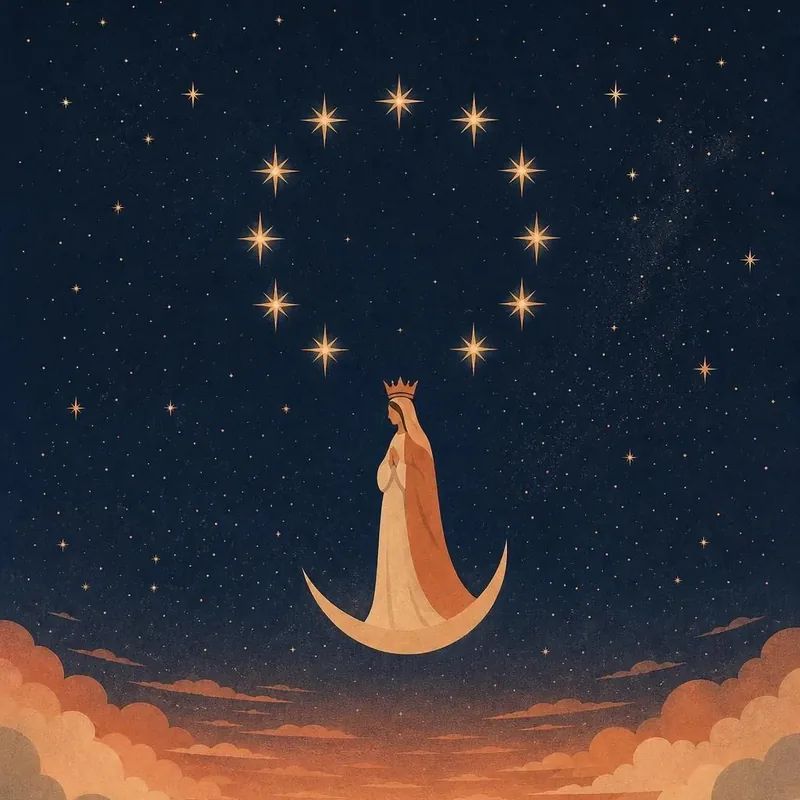
The Immaculate Conception is the Catholic dogma that Mary was preserved from original sin from the first moment of her conception, by a unique grace given through the merits of Christ. Pope Pius IX defined it on December 8, 1854. It refers to Mary's own conception, a separate teaching from the virgin birth of Jesus, and its feast falls on December 8, during Advent.
The Immaculate Conception is the Catholic teaching that Mary, the mother of Jesus, was free from original sin from the first moment of her existence. Pope Pius IX defined it as a dogma in 1854, and the Church keeps its feast every year on December 8.
The name causes a lot of confusion, because many people assume it refers to Jesus being conceived without a human father. This post explains what the dogma means and where it comes from, then turns to the December feast and the image of Mary standing on the moon.
What does the Immaculate Conception mean?
It means God kept Mary free from original sin from the moment she was conceived. Apart from Christ and his mother, every human being inherits that fallen condition from Adam. Mary was preserved from it by a unique grace, given in view of the saving work of her son. The Church teaches it as a dogma, a revealed truth.
Pius IX defined the doctrine on December 8, 1854, in the constitution Ineffabilis Deus (Catholic Encyclopedia). The Catechism quotes the definition in full: "The most Blessed Virgin Mary was, from the first moment of her conception, by a singular grace and privilege of almighty God and by virtue of the merits of Jesus Christ, Saviour of the human race, preserved immune from all stain of original sin" (CCC 491).
The Catechism links the privilege to Mary's vocation. When the angel Gabriel came to her, she had to give "the free assent of her faith," and for that "it was necessary that she be wholly borne by God's grace" (CCC 490). The grace given at her conception prepared her for the yes she gave at the Annunciation.
Is the Immaculate Conception the same as the virgin birth?
No. The Immaculate Conception concerns Mary's own conception in her mother's womb. The virginal conception concerns Jesus, whom the Church confesses was "conceived solely by the power of the Holy Spirit in the womb of the Virgin Mary" (CCC 496). Both are Catholic teachings, about two different people and two different moments.
The mix-up is easy to make. Both teachings involve Mary and a conception, and the feast falls in Advent, when Christians are preparing for the birth of Jesus. Many people hear "immaculate" and take it to mean a conception without a human father. That describes Jesus.
Mary had a human mother and father and was conceived in the ordinary way. The old Catholic Encyclopedia states it plainly: "the father had the usual share in its formation" (Catholic Encyclopedia). What was unique was the state of her soul, which from its first instant was filled with grace and free of original sin.
A simple way to keep the two apart: the Immaculate Conception prepared the mother, and the virginal conception brought the Son. The first is celebrated on December 8, the second on March 25, nine months before Christmas (Catholic Encyclopedia).
What is original sin, and what was Mary spared?
Original sin is the fallen condition every human being inherits from Adam: the loss of the holiness and justice God gave humanity at creation. It is a state people are born into, separate from the sins they personally choose. Mary was spared this state from her first moment, and by God's grace she also committed no personal sin.
The Catechism explains that original sin passes to all people through "the transmission of a human nature deprived of original holiness and justice" (CCC 404). It "does not have the character of a personal fault in any of Adam's descendants," and baptism "erases original sin and turns a man back towards God" (CCC 405). Mary was kept from it before it could reach her.
Personal sin is something a person does. It ranges from everyday venial sins to mortal sin, which breaks friendship with God. The Catechism teaches that "by the grace of God Mary remained free of every personal sin her whole life long" (CCC 493). The Immaculate Conception covers the first instant of her life, and her sinlessness covers everything after it.
Eastern Christians say the same in their own vocabulary: their Fathers call Mary "the All-Holy" (Panagia), as the Catechism notes (CCC 493).
Did Mary need a savior?
Yes. Jesus saved Mary as he saves everyone else. The difference lies in the timing: his grace reached her at the first moment of her life and kept her from original sin, while for others it comes later and frees them from it. The Church calls this redemption "in a more exalted fashion."
The Catechism says that Mary's unique holiness "comes wholly from Christ: she is 'redeemed, in a more exalted fashion, by reason of the merits of her Son'" (CCC 492). The Second Vatican Council made the same point and added that "because she belongs to the offspring of Adam she is one with all those who are to be saved" (Lumen Gentium 53).
Mary says it herself in the Magnificat: "my spirit rejoices in God my Savior" (Luke 1:47). A plain comparison helps. One person falls into a pit and is pulled out. Another is caught at the edge before she falls. Both owe their rescue to the same person.
So Catholic honor for Mary points back to her son: everything the Church praises in her is a gift she received. Our post on whether Catholics worship Mary explains where that honor ends and worship begins.
Where is the Immaculate Conception in the Bible?
No single verse states the doctrine. The Church finds its roots in two passages read together with Tradition: the angel Gabriel greeting Mary as "full of grace" (Luke 1:28), and God's promise of enmity between the serpent and the woman (Genesis 3:15). The full doctrine took centuries of reflection on texts like these.
Gabriel's words are "Hail, full of grace, the Lord is with you" (Luke 1:28), the greeting Catholics repeat in every Hail Mary and in the Angelus. John Paul II pointed out that the angel "calls her thus as if it were her real name" (Redemptoris Mater 8).
The second passage comes right after the fall. God tells the serpent, "I will put enmity between you and the woman, and between your seed and her seed" (Genesis 3:15). The Church calls this passage the Protoevangelium, the "first gospel" (CCC 410). The Catechism adds that "many Fathers and Doctors of the Church have seen the woman announced in the 'Proto-evangelium' as Mary, the mother of Christ, the 'new Eve'" (CCC 411).
Read on their own, both passages allow other interpretations. The Church describes the doctrine as the fruit of slow growth: "Through the centuries the Church has become ever more aware that Mary, 'full of grace' through God, was redeemed from the moment of her conception" (CCC 491).
Why did theologians debate it for centuries?
The doctrine seemed to collide with a central truth: Christ is the Savior of all. If Mary never contracted original sin, some theologians reasoned, she would have had no need of redemption. Thomas Aquinas held back for that reason. The Franciscan John Duns Scotus resolved the difficulty, and after him the doctrine steadily gained ground.
The feast was older than the theology, and it met resistance as it spread through the West in the Middle Ages. Bernard of Clairvaux protested when the canons of Lyons adopted it, and the Catholic Encyclopedia lists Peter Lombard, Albert the Great and Bonaventure among those quoted as opposing the doctrine (Catholic Encyclopedia).
Aquinas concluded in the Summa Theologiae that Mary contracted original sin and was cleansed of it before her birth. His concern was Christ's universal role: "If the soul of the Blessed Virgin had never incurred the stain of original sin, this would be derogatory to the dignity of Christ, by reason of His being the universal Saviour of all" (Summa Theologiae III, q. 27, a. 2).
Scotus answered with what Benedict XVI called the argument of "preventive Redemption." In this view the Immaculate Conception is "the masterpiece of the Redemption brought about by Christ," because Christ's love and mediation "obtained that the Mother be preserved from original sin." Benedict noted that Pius IX used the same argument in 1854 (Benedict XVI, General Audience, July 7, 2010).
From the time of Scotus, the doctrine became the common opinion in the universities. Sixtus IV adopted the feast for the whole Latin Church in 1476, and in 1708 Clement XI made it a holy day of obligation throughout the Church (Catholic Encyclopedia). The definition of 1854 closed the question for Catholics.
Four years later, at Lourdes, Bernadette Soubirous reported that the lady she saw gave her name. Preaching at Lourdes in 2008, Benedict XVI recalled that "during the apparition of 25 March 1858" she said: "I am the Immaculate Conception" (Benedict XVI, Lourdes, September 13, 2008).
When is the feast of the Immaculate Conception?
December 8, nine months before the feast of Mary's birth on September 8. Church law lists it among the holy days of obligation, and bishops' conferences may adjust that list for their countries. The feast always falls in the first or second week of Advent, the season of preparing for Christmas.
Canon law names "her Immaculate Conception" among the days that "must also be observed" alongside Sundays, and it allows a conference of bishops, with Rome's approval, to "suppress some of the holy days of obligation or transfer them to a Sunday" (canon 1246). The Catechism repeats the list (CCC 2177). Our guide to holy days of obligation explains how the rules differ by country.
In the United States, December 8 is the patronal feast of the country. The bishops' liturgical calendar lists it as a solemnity and a holy day of obligation, with Mass readings from Genesis 3, Ephesians 1 and Luke 1 (USCCB Liturgical Calendar 2026).
The setting in Advent fits. Advent prepares for the coming of Christ, and December 8 celebrates the first preparation God made for it: a mother ready to receive him. On that day priests set aside the violet of Advent for white vestments.
Why is Mary shown standing on the moon under twelve stars?
The image comes from Revelation 12:1, which describes "a woman clothed with the sun, with the moon under her feet, and on her head a crown of twelve stars." Christian tradition associates this woman with Mary and also reads her as the Church. In Rome, the statue on the column in Piazza di Spagna partly recalls the passage.
On the feast in 2011, after Revelation 12:1 had been proclaimed at the column, Benedict XVI explained its details (Benedict XVI, Act of Veneration, December 8, 2011). The sun shows Mary "clothed with God," filled with grace. The moon under her feet is "a symbol of death and of mortality," which Mary has left behind through her son's victory. The crown of twelve stars "symbolizes the 12 tribes of Israel" and places her "at the centre of the People of God."
The same image also stands for the Church. Benedict called it "at the same time Our Lady and the Church," and the Catholic Encyclopedia notes that commentators generally apply the passage first to the Church, while Mary "is both a figure of the Church, and its most prominent member" (Catholic Encyclopedia).
The Catechism applies to Mary a line from the Letter to the Ephesians about all believers: God chose her "in Christ before the foundation of the world, to be holy and blameless before him in love" (CCC 492). Every Christian is called to that holiness. Mary received it whole, from her first moment.
Common questions
Was Mary conceived without a human father? +
No. Mary had a human mother and father and was conceived in the ordinary way. As the Catholic Encyclopedia puts it, her father had the usual share in her formation. The Immaculate Conception concerns the state of her soul, which was free from original sin from its first instant.
Did Mary ever commit a sin? +
No. The Catechism teaches that "by the grace of God Mary remained free of every personal sin her whole life long" (CCC 493). This is a separate point from the Immaculate Conception, which concerns her first moment. Both rest on grace she received through Christ.
Do Catholics have to believe in the Immaculate Conception? +
Yes. It is a dogma, defined by Pius IX in 1854. The Catechism explains that the Church's teaching authority is exercised "to the fullest extent when it defines dogmas," proposing truths "contained in divine Revelation" (CCC 88). Catholics hold it as part of the faith.
Is the Immaculate Conception a holy day of obligation? +
In the universal law of the Church, yes (canon 1246). Bishops' conferences can suppress or move holy days, so practice varies by country. In the United States it is the patronal feast and keeps its obligation on any day of the week.
What does "I am the Immaculate Conception" mean? +
Bernadette Soubirous reported that the lady at Lourdes used these words on March 25, 1858, four years after the definition. The local bishop recognized the apparitions in 1862 (Catholic Encyclopedia), and private revelations "do not belong, however, to the deposit of faith" (CCC 67). The dogma rests on the 1854 definition, and Lourdes echoes it.