Who is the patron saint of travelers?
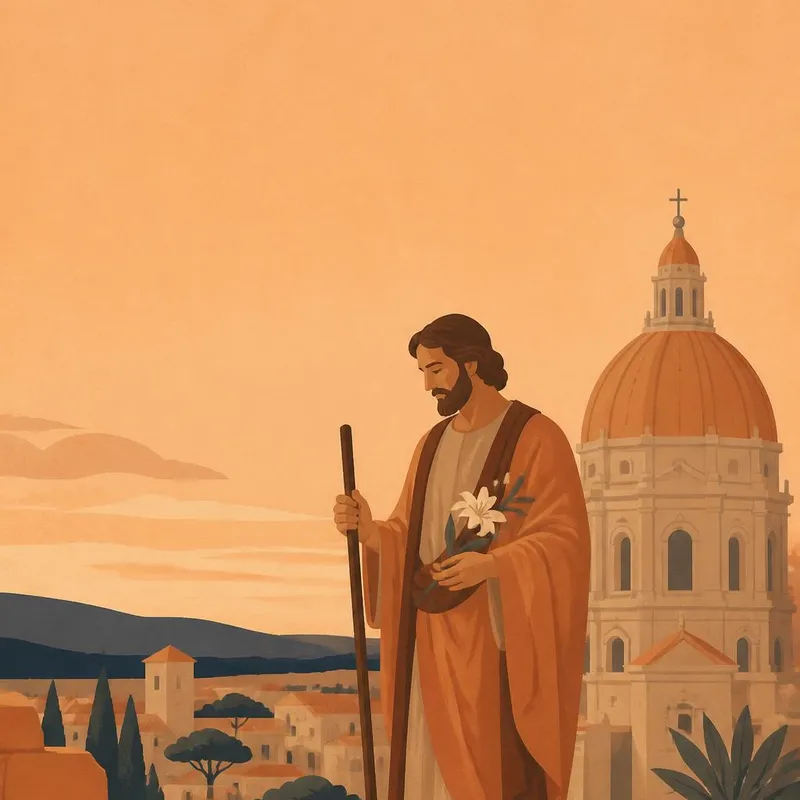
The patron saint of travelers is St. Christopher, the early martyr whose name means "Christ-bearer" and whose legend has him carrying the Christ Child across a dangerous river. The Church also names the Archangel Raphael, who guided Tobias in the Book of Tobit, as protector of travelers, and Our Lady of Loreto as patron of everyone who flies.
The patron saint of travelers is St. Christopher, an early martyr whose name means "Christ-bearer." Legend has him carrying the Christ Child across a dangerous river, and for centuries Christians have asked him to watch over them on the road. The Church also names the Archangel Raphael as a protector of travelers, and Our Lady of Loreto as patron of everyone who flies.
Many Catholics set out at Christmas with a quick prayer and a medal on the dashboard. This post explains who these patrons are, what the Church actually says about them, why Christopher left the general calendar without ceasing to be a saint, and how to pray before you leave.
Who is the patron saint of travelers?
St. Christopher is the best-known patron saint of travelers. The Archangel Raphael, who guided young Tobias in the Book of Tobit, is the other patron the Church names. Our Lady of Loreto is patron of air travelers, and St. Nicholas of sailors. Each patronage grew out of a story.
The clearest official statement comes from the Vatican's guidelines for pastoral care on the roads. "We recall Saint Christopher (Christ's Bearer), the presence of the Guardian Angel, and the Archangel Raphael who accompanied Tobias (Tobias 5:1 ff.), whom the Church regards as the protector of travellers" (Pontifical Council for Migrants, Guidelines for the Pastoral Care of the Road, 58). The same paragraph adds that Mary is invoked "as the Madonna of the Way, the Pilgrim Virgin."
So there is no single answer, and no need for one. Catholics turn to the saint whose story fits the trip. A driver may think of Christopher, a parent sending a child abroad of Raphael, a nervous flyer of Loreto. Our guide to choosing a patron saint explains how such patronages work in general.
Who was St. Christopher?
A martyr of the early Church, probably of the third century. Beyond that, the Catholic Encyclopedia admits, "almost nothing certain is known about his life or death." What survives is a legend: a giant who carried travelers across a river and one night carried Christ himself.
The legend runs like this. A man of great size and strength wanted to serve only the strongest master. A hermit taught him about Christ and baptized him. Christopher would not take on fasting or long prayers, but he "willingly accepted the task of carrying people, for God's sake, across a raging stream" (Catholic Encyclopedia: St. Christopher).
One day he carried a child who grew heavier with every step, "so that it seemed to him as if he had the whole world on his shoulders." On the far bank the child revealed himself as the Creator and Redeemer of the world. Christopher was later imprisoned and beheaded for the faith.
The encyclopedia reads the story as a parable. The name was first understood "in the spiritual sense of bearing Christ in the heart," and the river and the heavy child "may have been intended to denote the trials and struggles of a soul taking upon itself the yoke of Christ in this world." The man himself was real, though: "The existence of a martyr St. Christopher cannot be denied."
His link to travelers is old and practical. In 1386, the encyclopedia notes, "a brotherhood was founded under the patronage of St. Christopher in Tyrol and Vorarlberg, to guide travellers over the Arlberg," a high Alpine pass. His statues stood "at the entrances of churches and dwellings, and frequently at bridges," often with the inscription: "Whoever shall behold the image of St. Christopher shall not faint or fall on that day."
Why is the Archangel Raphael a patron of travelers?
Because in Scripture he does what a patron of travelers should do: he walks beside a young man on a long and dangerous trip, protects him and brings him home. The Book of Tobit tells the story. Raphael travels in disguise and only reveals who he is at the end.
Old Tobit, blind and poor, sends his son Tobias to recover money left in a distant city. A stranger offers to go with him. Tobit sends them off with a blessing: "Go with this man; God who dwells in heaven will prosper your way, and may his angel attend you" (Tobit 5:16). When the boy's mother weeps, Tobit reassures her: "For a good angel will go with him" (Tobit 5:21).
The blessing comes true. Tobias finds a wife, the money is recovered and his father's sight is healed. Only then does the companion say: "I am Raphael, one of the seven holy angels who present the prayers of the saints and enter into the presence of the glory of the Holy One" (Tobit 12:15). The Catholic Encyclopedia describes him as "the travelling companion of the younger Tobias" (Catholic Encyclopedia: St. Raphael).
Raphael's feast falls on September 29, shared with Michael and Gabriel, and the Guardian Angels follow on October 2 (USCCB Liturgical Calendar 2026). The Catechism teaches that every believer has such a companion: "Beside each believer stands an angel as protector and shepherd leading him to life" (CCC 336).
Is St. Christopher still a saint?
Yes. Christopher was taken off the Church's general calendar in 1969, but he was never removed from the list of saints. The reform cut back the many saints' days so that the feasts of Christ would stand out. Saints who are less known worldwide were left to local churches.
Pope Paul VI explained the change when he approved the new calendar. To carry out the decision of the Second Vatican Council, "the names of some saints have been removed from the universal Calendar, and the faculty has been given of re-establishing in regions concerned, if it is desired, the commemorations and cult of other saints" (Paul VI, Mysterii Paschalis). The old feast of Christopher on July 25 belongs today to St. James the Apostle (USCCB Liturgical Calendar 2026).
The Catholic Encyclopedia had already noted in 1908 how little is known for certain about his life. His martyrdom itself was never in doubt, and nothing in the change forbids honoring him. The Vatican named him first among the protectors of travelers in 2007, nearly forty years after the reform.
Being a saint does not depend on a date in the calendar. The Church holds that the saints "practiced heroic virtue and lived in fidelity to God's grace" and proposes them "as models and intercessors" (CCC 828). Our post on how someone becomes a saint explains how that recognition works, including for martyrs from centuries before any formal process existed.
Who is the patron saint of air travel?
Our Lady of Loreto. Pope Benedict XV named her patron of air travelers in 1920, and since 2019 her day has been on the general calendar on December 10. This year it falls on Thursday, December 10, 2026, in the second week of Advent.
The Vatican's office for travelers records that "On March 24 1920, Pope Benedict XV proclaimed our Lady of Loreto as universal Patron Saint of all those who travel by air" (Pontifical Council for Migrants: Protectress of Civil Aviation). The choice follows a tradition that angels carried the house of Nazareth to Loreto in Italy.
When Pope Francis added the memorial to the calendar, the decree said: "In a particular way all those who travel via aircraft have found in her their heavenly patron" (Decree on the celebration of the Blessed Virgin Mary of Loreto, 2019). In the United States December 10 is an optional memorial, which a priest may celebrate in place of the Advent weekday (USCCB Liturgical Calendar 2026).
Which other saints watch over travelers?
St. Nicholas for sailors and those at sea, and the Holy Family for anyone who has to leave home. Many Catholics also pray to their own guardian angel. Each has a story that ties them to the road or the sea.
St. Nicholas was invoked by sailors because tradition says he calmed a storm at sea. The Catholic Encyclopedia lists him as "patron of mariners, merchants, bakers, travellers, children, etc." (Catholic Encyclopedia: St. Nicholas of Myra). His feast on December 6 opens the season of Christmas travel. Our post Who is St. Nicholas? tells his story.
The Holy Family travelled more than most. Joseph took Mary, who was expecting a child, from Nazareth to Bethlehem "to be enrolled" (Luke 2:4-5). Soon after, an angel warned him to flee, and "he rose and took the child and his mother by night, and departed to Egypt" (Matthew 2:14). Families on the move, refugees above all, have prayed to them ever since. The Church keeps their feast on Sunday, December 27, 2026 (USCCB Liturgical Calendar 2026).
Why do Catholics ask saints to protect them on a trip?
Because the saints are alive with God and can pray for us. Asking a saint to watch over a trip is asking a friend in heaven to pray, the same way you would ask a friend at home. The protection comes from God. The saint's part is intercession.
The Catechism says the saints "do not cease to intercede with the Father for us" (CCC 956). They "constantly care for those whom they have left on earth," and "we can and should ask them to intercede for us and for the whole world" (CCC 2683). Our post on the communion of saints explains why death does not break that bond.
The Vatican guidelines keep the order clear: "God is the rock of Christian hope," and the saints are "His and our true friends" (Guidelines for the Pastoral Care of the Road, 58). The same document asks drivers for courtesy, prudence and sobriety. A medal does not replace a seatbelt.
The St. Christopher medal is a sacramental, a sign the Church blesses to dispose us to grace. The Catechism counts "medals" among the forms of popular piety (CCC 1674). It also warns against treating them as charms: "To attribute the efficacy of prayers or of sacramental signs to their mere external performance, apart from the interior dispositions that they demand, is to fall into superstition" (CCC 2111). Our post What is a sacramental? explains the difference.
What prayer can you say before a trip?
Begin with the Sign of the Cross, then ask your patrons for their prayers: "St. Christopher, pray for us. St. Raphael, pray for us. Our Lady of Loreto, pray for us." Psalm 121 makes a good prayer for the road. On a long drive, many families pray the Rosary together.
The Vatican guidelines recommend making the Sign of the Cross before you set out, because with it "we put ourselves directly under the protection of the Holy Trinity" (Guidelines for the Pastoral Care of the Road, 59). They also quote the psalm that Christians have prayed on the road for centuries: "For he will give his angels charge of you to guard you in all your ways" (Psalm 91:11).
Psalm 121 ends with a verse to say as you close the front door: "The Lord will keep your going out and your coming in from this time forth and for evermore" (Psalm 121:8).
For a long drive, the guidelines suggest praying aloud and taking turns, "as when reciting the Rosary which, due to its rhythm and gentle repetition, does not distract the driver's attention" (Guidelines for the Pastoral Care of the Road, 60). Our step-by-step guide to praying the Rosary has every prayer you need.
When you arrive, give thanks. Before Raphael leaves Tobit and his son, he tells them: "Do not be slow to give him thanks" (Tobit 12:6).
Common questions
Is St. Christopher the patron saint of travelers? +
Yes. He is the best-known patron of travelers, drivers and everyone on the road. The Vatican's guidelines for the pastoral care of the road name him first among the saints to whom travelers entrust themselves, together with the guardian angel and the Archangel Raphael.
Who is the patron saint of air travel? +
Our Lady of Loreto. Pope Benedict XV proclaimed her patron of all who travel by air in 1920. Her optional memorial is on December 10 in the General Roman Calendar.
Was St. Christopher removed as a saint? +
No. In 1969 his feast left the general calendar in a reform that handed many saints over to local churches, but he remains a saint and may still be honored. In 2007 the Vatican still named him a protector of travelers.
Is it superstitious to wear a St. Christopher medal? +
Not in itself. A blessed medal is a sacramental, a reminder to pray and to trust God. It becomes superstition only when someone treats it as a charm that works without faith or prayer (CCC 2111).
Who is the patron saint of sailors? +
St. Nicholas of Myra, who according to tradition calmed a storm at sea. The Catholic Encyclopedia lists him as patron of mariners and travellers. Sailors also invoke Mary as Star of the Sea.