Who is St. Nicholas?
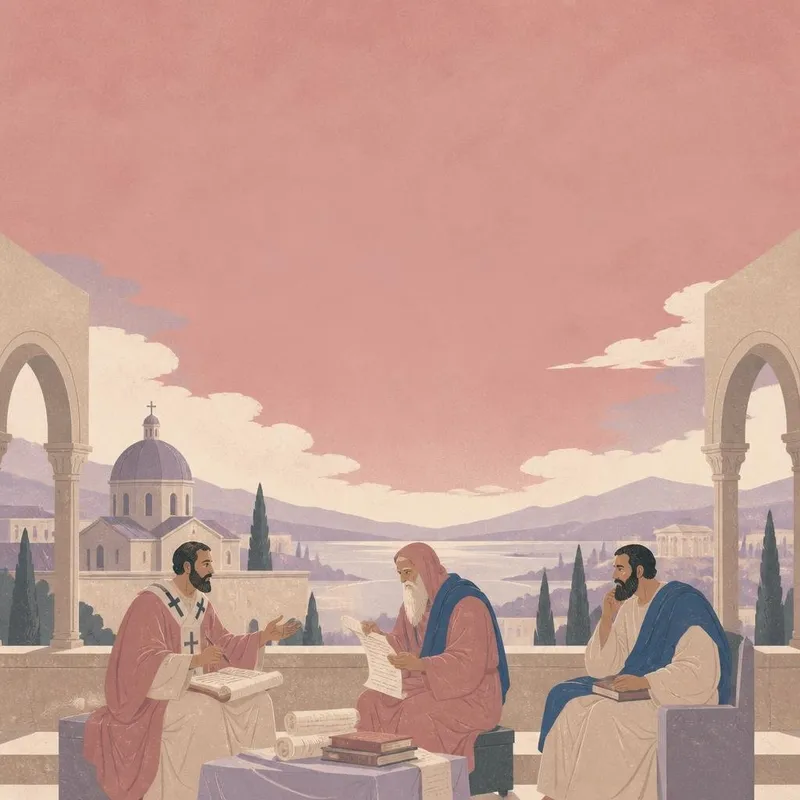
St. Nicholas was the bishop of Myra, in today's Turkey, in the fourth century. Tradition remembers him for secret gifts to the poor, above all three dowries thrown through a window by night. His feast is December 6, and Santa Claus grew out of his Dutch name, Sinterklaas.
St. Nicholas was the bishop of Myra, a port city in what is now southern Turkey, in the fourth century. He is remembered for giving in secret to people in need. The Church keeps his day on December 6, and the gift-bringer known as Santa Claus grew out of his name and his story.
Few saints are as widely loved and as thinly documented. This post sorts out what history can say about him, where the stories of gold and gifts come from, why his bones rest in Italy, how he turned into Santa Claus, and how Catholics keep his day.
Who is St. Nicholas?
St. Nicholas is a saint of the early Church: the bishop of Myra in Lycia, on the southern coast of today's Turkey, in the fourth century. Catholics and Orthodox Christians both honor him on December 6. He is the patron of children and sailors, and the historical figure behind Santa Claus.
He is sometimes called Nicholas of Myra, after the city he served, and sometimes Nicholas of Bari, after the Italian city that has kept his relics since 1087. Both names mean the same man.
The Church has never treated him as a fairy tale. She counts him among the saints, the men and women who, in the Catechism's words, "practiced heroic virtue and lived in fidelity to God's grace" and whom she proposes to believers "as models and intercessors" (CCC 828). Nicholas lived centuries before Rome had a formal process for declaring saints. Christians simply honored him, first at his tomb and then far beyond it. Our post on how someone becomes a saint explains how the later process grew out of that kind of devotion.
What do we know about his life?
Very little for certain. The Catholic Encyclopedia says "there is scarcely anything historically certain about him except that he was Bishop of Myra in the fourth century." The rest comes from a tradition written down centuries later: birth at Patara, an inheritance given away, prison under Diocletian, and death on December 6.
That tradition runs as follows. Nicholas was born at Patara, a seaside town in Lycia, in the third century, to a Christian family. He lost his parents young and, in the words of the Vatican News account of his life, "remembering the rich young man in the Gospel, used his inheritance to assist the needy, the sick, and the poor" (Vatican News: St. Nicholas of Bari, Bishop of Myra). The reference is to the words of Jesus: "If you would be perfect, go, sell what you possess and give to the poor, and you will have treasure in heaven; and come, follow me" (Matthew 19:21).
He was chosen bishop of Myra. When the emperor Diocletian persecuted the Church, Nicholas was "cast into prison" and "released after the accession of Constantine" (Catholic Encyclopedia: St. Nicholas of Myra). He died on December 6. The year is uncertain: Vatican News gives 343, the Catholic Encyclopedia 345 or 352.
These stories, the same encyclopedia notes, "were first collected and written in Greek by Metaphrastes in the tenth century," some six hundred years after the events. The devotion itself, though, is early. "As early as the sixth century Emperor Justinian I built a church in his honour at Constantinople" (Catholic Encyclopedia: St. Nicholas of Myra). A bishop with a church in the imperial capital two centuries after his death was not invented by storytellers.
Why is St. Nicholas linked to gifts?
Because of one story above all. A poor father could not give his three daughters a dowry. Nicholas came by night and threw a bag of coins through the window, three times, so that each daughter could marry. He wanted no one to know. Every later gift custom goes back to that story.
Vatican News counts it among "the most ancient stories about Saint Nicholas." The stakes were high: "The family was poor, and the young girls were in danger of being forced into prostitution, because their father could not afford to offer a suitable dowry." Nicholas "threw a bag of coins through the open window" and left before anyone saw him. He came back twice. The third time the father ran out to see who his benefactor was, and "Nicholas begged him not to tell anyone what he had done" (Vatican News: St. Nicholas of Bari, Bishop of Myra).
The secrecy is the heart of the story. Jesus taught: "But when you give alms, do not let your left hand know what your right hand is doing, so that your alms may be in secret; and your Father who sees in secret will reward you" (Matthew 6:3-4). Nicholas does exactly that. The gift meets a real need and earns him no credit.
The Catechism gives this kind of giving a high place. Among the works of mercy, it says, "giving alms to the poor is one of the chief witnesses to fraternal charity: it is also a work of justice pleasing to God" (CCC 2447). A shoe filled in the night is a child-sized picture of that teaching.
Other stories show the same character. On a sea voyage during a pilgrimage to the Holy Land a storm threatened to sink his ship, and "Nicholas calmly prayed, and suddenly the wind ceased and the waves died down." Others tell of three murdered students restored to life and a kidnapped boy brought home. Vatican News sums them up as "all testifying to a life spent in service to the weak, the small, and the defenceless."
Was St. Nicholas at the Council of Nicaea?
Tradition says yes, but historians doubt it. The council met in 325 to defend the divinity of Christ against the priest Arius. Nicholas was a bishop in the region at about that time, yet his name is missing from the old lists of the bishops who attended.
The Catholic Encyclopedia puts it plainly: "There is reason to doubt his presence at Nicaea, since his name is not mentioned in any of the old lists of bishops that attended this council" (Catholic Encyclopedia: St. Nicholas of Myra). Vatican News follows the tradition and says that after his release from prison "he attended the Council of Nicea in 325."
What the council did is not in doubt. It "confessed in its Creed that the Son of God is 'begotten, not made, of the same substance (homoousios) as the Father', and condemned Arius" (CCC 465). A popular later story has Nicholas striking Arius across the face in the council hall. It appears in none of the early sources and is best left as legend.
Why are his relics in Bari?
Because sailors from Bari took them there in 1087. Myra had come under Turkish rule, and merchants from the Italian port carried the saint's bones home across the sea. A basilica was built over them, and Bari has been the center of his devotion in the West ever since.
The Catholic Encyclopedia does not soften it: "In 1087 Italian merchants stole his body at Myra, bringing it to Bari in Italy." Venice wanted the relics too, Vatican News adds, "but sailors from Bari were able to acquire his relics first." Two years later the bones were laid in the crypt of a new church. "The relics were placed under the altar by the reigning Pope, Urban II" (Vatican News: St. Nicholas of Bari, Bishop of Myra).
Because Nicholas is loved in the East and the West alike, his tomb has become a meeting place for divided Christians. Benedict XVI called Bari "a city that preserves the bones of St Nicholas, a land of encounter and dialogue with our Christian brethren of the East" (Homily, 29 May 2005). Pope Francis gathered the heads of the Middle Eastern churches there in July 2018. Later that year he wrote that the basilica's work for unity had been helped by "the sincere devotion to the Holy Bishop of Myra by the faithful of the East and of the West" (Letter, 24 November 2018).
How did St. Nicholas become Santa Claus?
Through the Dutch. In the Low Countries the saint was called Sint Nikolaas, shortened to Sinterklaas, and he brought children gifts on the eve of December 6. In America the name became Santa Claus and the visit moved to Christmas Eve. The bishop's mitre and staff were lost along the way.
Vatican News describes the older custom: "on the Eve of his feast, children would leave socks or shoes on a chair, or next to the fireplace, and go to sleep trusting that the following morning they would be filled with gifts" (Vatican News: St. Nicholas of Bari, Bishop of Myra). The Catholic Encyclopedia, writing in 1911, already noted the change across the Atlantic: "in the United States and some other countries St. Nicholas has become identified with Santa Claus who distributes gifts to children on Christmas eve" (Catholic Encyclopedia: St. Nicholas of Myra).
The red suit, the reindeer and the North Pole are modern additions. Beneath them the outline of the bishop is still visible: a visitor who comes at night, gives to children and leaves unseen.
Catholic parents sometimes wonder what to tell their children. The saint gives them a truthful answer: Nicholas is real, and the Church believes he is alive with God. The Catechism says of the saints that they "constantly care for those whom they have left on earth" (CCC 2683). Our post on the communion of saints explains that bond.
What is St. Nicholas the patron saint of?
Children, sailors, merchants, bakers and travellers, to begin with. The Catholic Encyclopedia lists him as "patron of mariners, merchants, bakers, travellers, children, etc.," and names Greece, Russia, Sicily and Lorraine among the places under his care. Few saints have been claimed by so many trades and countries.
Each patronage has a story behind it. Sailors claim him because of the storm he calmed. Children claim him because of the three daughters, the three students and the boy brought home. As Vatican News puts it, "These and similar stories helped to spread devotion to Saint Nicholas as patron of children and young people."
A patron is more than a mascot. The Catechism says that the "patron saint provides a model of charity; we are assured of his intercession" (CCC 2156). The saints in heaven "do not cease to intercede with the Father for us" (CCC 956).
His name has travelled as far as his fame: Nicholas, Nicole, Nicola, Niklas, Klaus, Colin, Nikolai, Mikołaj. Anyone who bears one of these names can keep December 6 as a name day. Our posts on finding your name day and choosing a patron saint explain how.
How do Catholics celebrate St. Nicholas Day?
On the evening of December 5 children put out their shoes or hang up a stocking. In the morning they find small gifts inside: oranges, nuts, chocolate coins. Families tell the story of the three dowries, and many give something quietly to a person in need. The day falls early in Advent.
In the Church's calendar December 6 is an optional memorial of "Saint Nicholas, Bishop" (USCCB Liturgical Calendar 2026). A priest may offer the Mass of the saint that day or the Mass of the Advent weekday. In 2026, December 6 is the Second Sunday of Advent, and the Sunday takes precedence (USCCB Liturgical Calendar 2027). The customs at home go on as usual.
The Catechism explains why the Church keeps such days at all. In the memorials of the saints she "proposes them to the faithful as examples who draw all men to the Father through Christ" (CCC 1173). Nicholas fits the season well. Advent prepares for the coming of Christ, the gift no one earned, and here is a saint known for giving without being asked.
Keeping the day takes little. Put out the shoes, tell the children who Nicholas was, then do as he did: give something to someone who needs it and tell no one. St. Paul hands on a saying of Jesus that fits the day: "It is more blessed to give than to receive" (Acts 20:35).
The man behind the red suit turns out to be more interesting than the costume: a bishop who gave his own money away at night and asked not to be named.
Common questions
When is St. Nicholas Day? +
December 6 in the Catholic Church. In many countries children receive their gifts on the evening of December 5 or the morning of December 6. In 2026 the date falls on the Second Sunday of Advent, so the Sunday liturgy takes precedence at Mass (USCCB Liturgical Calendar 2027).
Is St. Nicholas the same as Santa Claus? +
Santa Claus comes from St. Nicholas. The name is the Dutch Sinterklaas in English form, and the Catholic Encyclopedia notes that in the United States St. Nicholas "has become identified with Santa Claus." The saint himself was a fourth-century bishop in what is now Turkey, not a figure from the North Pole.
Was St. Nicholas a real person? +
Yes. He was bishop of Myra in the fourth century, and by the sixth century an emperor had built a church in his honor in Constantinople. The details of his life, including the famous gifts of gold, come from traditions written down much later.
Did the Church remove St. Nicholas from the calendar? +
No. He remains in the Roman calendar on December 6 as an optional memorial, which means a priest may celebrate his Mass that day but is not required to (USCCB Liturgical Calendar 2026). His day was never abolished.
Why do children put out shoes for St. Nicholas? +
The custom recalls the bags of coins he is said to have thrown through a poor family's window at night. In the Low Countries and German-speaking lands, children left shoes or socks out on the eve of his feast and found them filled in the morning.