What is the communion of saints?
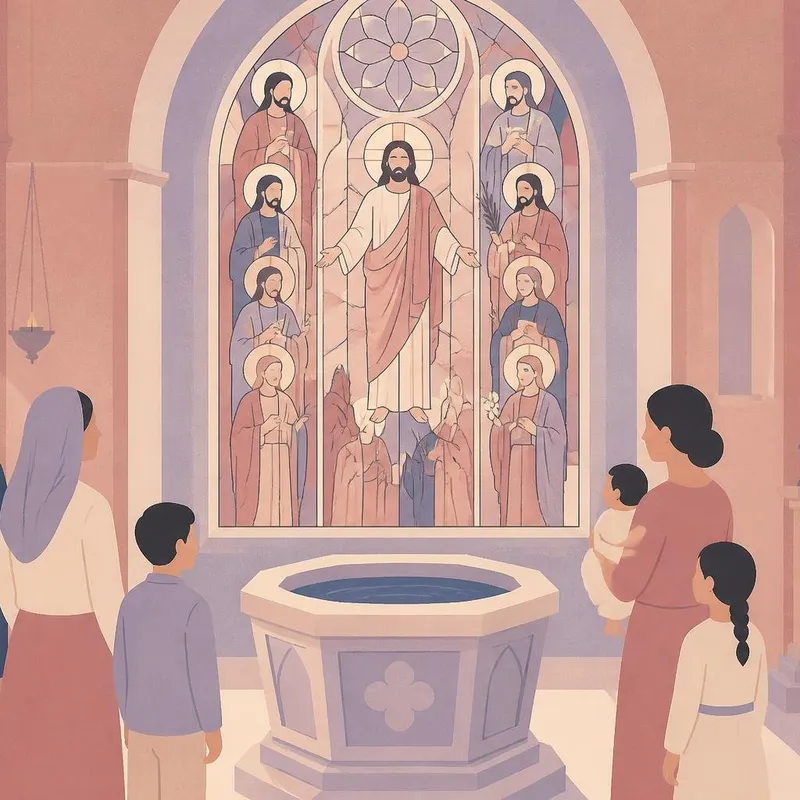
The communion of saints is the whole Church as one body in Christ: the faithful on earth, the dead being purified in purgatory and the saints in heaven, sharing one life and one fund of spiritual goods, above all the Eucharist. The saints in heaven pray for us, we pray for the dead, and all three states meet at every Mass. None of this takes away from Christ, because every grace the saints pass on comes from him.
The communion of saints is the Church understood as one body: the faithful on earth, the dead who are being purified and the blessed in heaven, all joined to Christ and to one another. Catholics profess it every time they say the Apostles' Creed, right after "the holy catholic Church" and before "the forgiveness of sins."
The phrase does two jobs at once. It names a sharing in holy things, above all the Eucharist, and a sharing among holy persons across death. This post explains both and what they change in practice.
What does "communion of saints" mean?
The communion of saints means that all who belong to Christ form one body and share one life, so that the goods of each are communicated to all. The Catechism puts it in six words: "The communion of saints is the Church" (CCC 946).
The article follows directly from the one before it. After confessing "the holy catholic Church," the Creed adds "the communion of saints," and the Catechism reads the second as a further explanation of the first, quoting an early bishop: "What is the Church if not the assembly of all the saints?" (CCC 946).
The Latin behind the phrase is communio sanctorum, and sanctorum can mean holy things or holy persons. The Catechism keeps both. The term "has two closely linked meanings": a "communion in holy things" and a communion "among holy persons" (CCC 948). The holy things are the faith, the sacraments and charity itself; the holy persons are everyone united to Christ, living or dead.
The practical upshot is a common fund. Quoting St. Thomas Aquinas, the Catechism says: "Since all the faithful form one body, the good of each is communicated to the others" (CCC 947). The summary at the end of the section makes the same point from the other side: "what each one does or suffers in and for Christ bears fruit for all" (CCC 961).
Who belongs to the communion of saints?
Three groups belong to it: Catholics still on earth, the dead who are being purified in purgatory, and the saints in heaven. The Church calls these her three states. They are not three Churches but one, at different points on the same road.
The Second Vatican Council set out the picture in its constitution on the Church, and the Catechism quotes it: "some of his disciples are pilgrims on earth. Others have died and are being purified, while still others are in glory," and all of them "in varying degrees and in different ways share in the same charity towards God and our neighbours" (CCC 954).
Death does not break the bond. The Council taught that "the union of the wayfarers with the brethren who sleep in the peace of Christ is in no way interrupted," but "is reinforced by an exchange of spiritual goods" (CCC 955). Pope Paul VI said the same in his Credo of the People of God, which the Catechism cites as its last word on the subject: "We believe in the communion of all the faithful of Christ, those who are pilgrims on earth, the dead who are being purified, and the blessed in heaven, all together forming one Church" (CCC 962).
Membership begins at Baptism, "the gate by which we enter into the Church" (CCC 950). The Church's two November feasts honor the other two states in turn, and our post on All Saints' Day and All Souls' Day explains how they differ.
Where is the communion of saints in the Bible?
The phrase itself is not in Scripture, but the idea runs through the New Testament: the Church is one body in Christ, the members share each other's joys and sufferings, and the dead in Christ remain part of the family.
The core text is Paul on the body of Christ: "If one member suffers, all suffer together; if one member is honored, all rejoice together. Now you are the body of Christ and individually members of it" (1 Corinthians 12:26 to 27). The first Christians lived this from the start: they "devoted themselves to the apostles' teaching and fellowship, to the breaking of bread and the prayers" (Acts 2:42).
The letter to the Hebrews extends the body across death. After listing the faithful of the Old Testament it says, "since we are surrounded by so great a cloud of witnesses," let us "run with perseverance the race that is set before us" (Hebrews 12:1). Revelation shows the elders in heaven holding "golden bowls full of incense, which are the prayers of the saints" (Revelation 5:8). And the Second Book of Maccabees records prayer for the dead as "a holy and pious thought" (2 Maccabees 12:45), the verse the Council and the Catechism both cite for the Church's care for the departed (CCC 958).
How do the saints in heaven help us?
The saints help us by praying for us. Because they are more closely united to Christ than we are, their prayer for the Church is constant, and the Church asks for it. Catholics do not pray to the saints instead of God; they ask the saints to pray with them and for them.
The Council's teaching, quoted in the Catechism, is direct: "They do not cease to intercede with the Father for us, as they proffer the merits which they acquired on earth through the one mediator between God and men, Christ Jesus." The passage ends: "So by their fraternal concern is our weakness greatly helped" (CCC 956). In its section on prayer the Catechism adds that the saints "contemplate God, praise him and constantly care for those whom they have left on earth." Its conclusion: "We can and should ask them to intercede for us and for the whole world" (CCC 2683).
Two saints said as much on their deathbeds, and the Catechism quotes them side by side. St. Dominic told his brothers: "Do not weep, for I shall be more useful to you after my death and I shall help you then more effectively than during my life." St. Thérèse of Lisieux said: "I want to spend my heaven in doing good on earth" (CCC 956).
Asking a saint's prayer is no different in kind from asking a friend's. Scripture tells Christians to "pray for one another," because "The prayer of a righteous man has great power in its effects" (James 5:16). Our guide to choosing a patron saint explains how to take one of them as a particular companion.
How can we help the souls in purgatory?
We help the dead by praying for them, by having Mass offered for them, by almsgiving and by gaining indulgences on their behalf. This is the communion of saints running in the other direction: the living helping those who can no longer help themselves.
The Catechism describes the practice as original to the faith. "From the beginning the Church has honored the memory of the dead and offered prayers in suffrage for them, above all the Eucharistic sacrifice," and it also "commends almsgiving, indulgences, and works of penance undertaken on behalf of the dead" (CCC 1032). The Mass is offered for the faithful departed who "have died in Christ but are not yet wholly purified," and the Catechism illustrates the point with St. Monica's last request to her son Augustine: "I simply ask you to remember me at the Lord's altar wherever you are" (CCC 1371).
The help flows both ways: "Our prayer for them is capable not only of helping them, but also of making their intercession for us effective" (CCC 958).
The teaching on indulgences rests on the same idea. In the communion of saints, the Catechism says, "a perennial link of charity exists between the faithful who have already reached their heavenly home, those who are expiating their sins in purgatory and those who are still pilgrims on earth", and in this exchange "the holiness of one profits others, well beyond the harm that the sin of one could cause others" (CCC 1475). Our posts on purgatory, on how to pray for the dead and on what an indulgence is go into each part.
Why does the Eucharist matter for the communion of saints?
The Eucharist is where the communion of saints is most fully real. It is the holiest of the holy things the phrase refers to, and in every Mass the Church on earth joins the Church in heaven and prays for the Church in purgatory.
The Catechism's summary says the expression refers first to the "holy things" (sancta), "above all the Eucharist," by which "the unity of believers, who form one body in Christ, is both represented and brought about" (CCC 960). Quoting the Roman Catechism, it says the name communion suits the Eucharist better than any other sacrament, "because it is primarily the Eucharist that brings this communion about" (CCC 950).
All three states meet at the altar. "To the offering of Christ are united not only the members still here on earth, but also those already in the glory of heaven." The Church offers the sacrifice "In communion with and commemorating the Blessed Virgin Mary and all the saints" (CCC 1370). The Council put it the same way: "Celebrating the Eucharistic sacrifice therefore, we are most closely united to the Church in heaven" (Lumen Gentium 50). Our post on the Eucharist explains what Catholics believe happens at that moment.
Does the communion of saints take away from Christ?
No. The saints have nothing of their own to give; whatever they pass on, they received from Christ. The Church teaches that honoring the saints and asking their prayers leads to Christ rather than away from him, and that it enriches the worship owed to God alone.
The Council faced the objection head on. Our communion with those in heaven, it taught, "in no way weakens, but conversely, more thoroughly enriches the latreutic worship we give to God the Father, through Christ, in the Spirit" (Lumen Gentium 51). Latreutic worship, or adoration, is given to God and never to a creature. The Catechism keeps the order clear: "our communion with the saints joins us to Christ, from whom as from its fountain and head issues all grace, and the life of the People of God itself" (CCC 957).
Nor is the one mediator replaced. Scripture says that "there is one mediator between God and men, the man Christ Jesus" (1 Timothy 2:5), and the Council's own text on the saints' intercession cites that verse (CCC 956).
The Council also warned against overdoing it. The authentic cult of the saints "consists not so much in the multiplying of external acts, but rather in the greater intensity of our love," and the faithful should seek from the saints "example in their way of life, fellowship in their communion, and aid by their intercession" (Lumen Gentium 51). The same distinction answers the older question of whether Catholics worship Mary.
How do you live the communion of saints?
You live it by taking the three states seriously: pray for the living, pray for the dead, and ask the saints to pray for you. Then go to Mass, where all three are present at once.
Start with the living. The Catechism says that in this solidarity "the least of our acts done in charity redounds to the profit of all" and that "Every sin harms this communion" (CCC 953). Pray by name for the people who have asked you to, and ask others to pray for you.
Then the dead. Keep a list of the departed you owe prayer to, and bring it to Mass in November. Have a Mass offered for a parent or grandparent on an anniversary.
Then the saints. Learn the life of your patron and of the saint whose feast falls on your birthday. Ask a saint for prayer in a concrete need, and consider a novena when the need is serious.
The Council summed up the whole article in one sentence that the Catechism repeats: if we "continue to love one another and to join in praising the Most Holy Trinity" then "all of us who are sons of God and form one family in Christ" will "be faithful to the deepest vocation of the Church" (CCC 959). That family is the communion of saints, and you are already in it.
Common questions
Is the communion of saints in the Apostles' Creed? +
Yes. The Apostles' Creed says, "I believe in the Holy Spirit, the holy catholic Church, the communion of saints, the forgiveness of sins, the resurrection of the body, and life everlasting" (USCCB, Apostles' Creed). The Catechism treats the phrase as a further explanation of "the holy catholic Church" (CCC 946). The Nicene Creed does not contain it.
Are the souls in purgatory part of the communion of saints? +
Yes. The Church speaks of three states of her members: pilgrims on earth, the dead who are being purified, and the saints in glory (CCC 954). The souls in purgatory are assured of heaven and can be helped by our prayers, and the Catechism teaches that our prayer also makes their intercession for us effective (CCC 958).
Can the saints hear our prayers? +
The Church teaches that they can and that they respond. The saints "constantly care for those whom they have left on earth" and "We can and should ask them to intercede for us and for the whole world" (CCC 2683). Revelation pictures the elders in heaven presenting "the prayers of the saints" before God (Revelation 5:8).
What is the difference between the communion of saints and All Saints' Day? +
The communion of saints is a permanent reality, the whole Church united in Christ across earth, purgatory and heaven. All Saints' Day, November 1, is a single feast that honors one part of it: everyone who is already in heaven. All Souls' Day, November 2, is the day set aside for the dead still being purified.
Does praying to the saints replace praying to God? +
No. Adoration belongs to God alone, and asking a saint's prayer is like asking a friend's. The Council taught that communion with the saints "in no way weakens" the worship given to God but "more thoroughly enriches" it (Lumen Gentium 51), and every grace the saints pass on comes from Christ (CCC 957).