What is Holy Week?
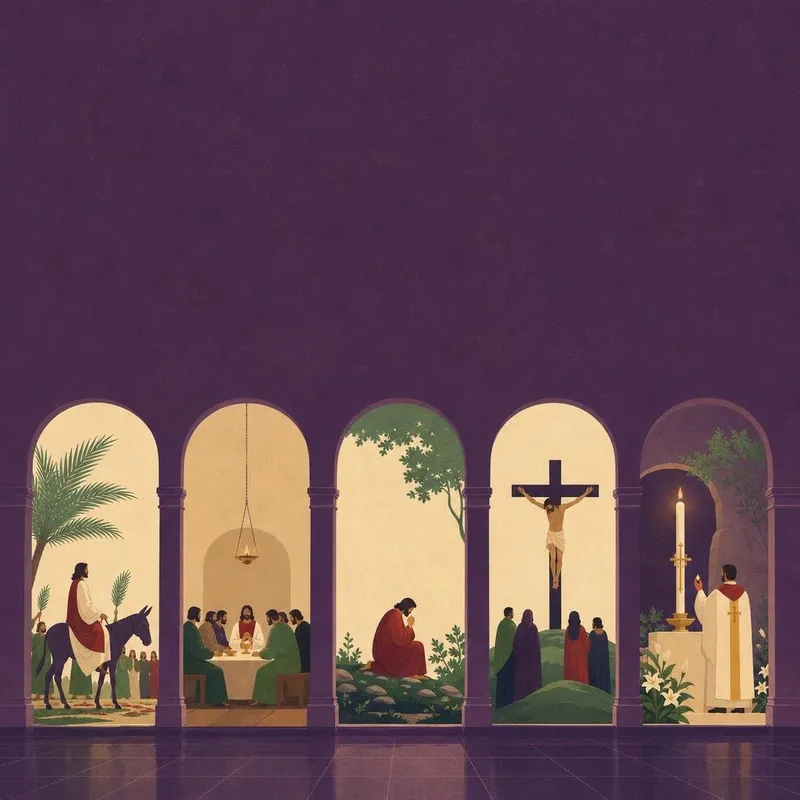
Holy Week is the last week of Lent, from Palm Sunday to the Easter Vigil, in which the Church remembers Jesus' entry into Jerusalem, the Last Supper, his Passion and death, and his rest in the tomb. Its last days form the Easter Triduum: Holy Thursday evening, Good Friday and Holy Saturday. In 2027 Holy Week runs from Palm Sunday, March 21, to Easter Sunday, March 28.
Holy Week is the last week of Lent, the seven days in which the Church remembers the final days of Jesus' life on earth: his entry into Jerusalem, the Last Supper, his Passion and death, and his rest in the tomb. It begins on Palm Sunday and ends with the Easter Vigil. In 2027 it runs from Sunday, March 21, to Easter Sunday, March 28.
This post explains what Holy Week is, the dates for 2027, and what happens on each day, from the palms of Sunday to the empty altar of Good Friday and the quiet of Holy Saturday.
What is Holy Week?
Holy Week is the week before Easter, in which the Church celebrates the events of Jesus' last days in Jerusalem. It opens with Palm Sunday, includes the Chrism Mass, and ends with the Easter Triduum: Holy Thursday evening, Good Friday, Holy Saturday and the Easter Vigil.
The Church's own description is short. The Directory on Popular Piety and the Liturgy says: "In Holy Week, the Church celebrates the mysteries of salvation accomplished by Christ in the last days of the earthly life, beginning with his messianic entry into Jerusalem" (Directory on Popular Piety and the Liturgy 138).
The week has two parts. The first four days, from Palm Sunday to Wednesday, still belong to Lent. Then, on Thursday evening, Lent ends and the Triduum begins, which the Church treats as one continuous celebration rather than three separate days. The whole week leads to Easter, and our post on when Easter 2027 is covers the Resurrection and the fifty days that follow.
When is Holy Week 2027?
Holy Week 2027 begins on Palm Sunday, March 21, and ends on Holy Saturday, March 27, with the Easter Vigil after nightfall. Holy Thursday is March 25, Good Friday March 26, and Easter Sunday March 28, 2027.
The dates come from the official calendar of the United States bishops (USCCB Liturgical Calendar 2027), which lists each day by its liturgical name and colour:
- Sunday, March 21: Palm Sunday of the Passion of the Lord, in red.
- Monday, March 22, to Wednesday, March 24: Monday, Tuesday and Wednesday of Holy Week, in violet.
- Thursday, March 25: Thursday of Holy Week (Holy Thursday), with the Chrism Mass and the Evening Mass of the Lord's Supper.
- Friday, March 26: Friday of the Passion of the Lord (Good Friday), in red.
- Saturday, March 27: Holy Saturday, with the Easter Vigil.
- Sunday, March 28: Easter Sunday of the Resurrection of the Lord.
Holy Thursday 2027 falls on March 25, the usual date of the Annunciation. The calendar notes: "Since March 25 is Thursday of Holy Week (Holy Thursday), the Solemnity of the Annunciation of the Lord is transferred to Monday, April 5." Lent itself began on Ash Wednesday, February 10, as our post on when Lent 2027 starts explains.
What happens on Palm Sunday?
Palm Sunday remembers Jesus' entry into Jerusalem, when the crowds greeted him with branches. Mass begins with a blessing of palms and a procession, and the Gospel of the Passion is read. The day joins two things: Christ's welcome as king and the suffering that follows within a week.
The Catechism makes Palm Sunday the door of the whole week: "Jesus' entry into Jerusalem manifested the coming of the kingdom that the King-Messiah was going to accomplish by the Passover of his Death and Resurrection. It is with the celebration of that entry on Palm Sunday that the Church's liturgy solemnly opens Holy Week" (CCC 560).
The crowd's words are still said at every Mass. Saint Matthew records that they shouted, "Blessed is he who comes in the name of the Lord" (Matthew 21:9). The Catechism points out that this acclamation "is taken up by the Church in the Sanctus of the Eucharistic liturgy that introduces the memorial of the Lord's Passover" (CCC 559).
The other name of the day is Passion Sunday. The Directory says Palm Sunday "unites the royal splendour of Christ with the proclamation of his Passion" (Directory 139). In 2027, Year B of the Sunday cycle, the Passion is read from Saint Mark, chapters 14 and 15.
Most Catholics take a blessed palm home. The Directory asks that it be understood correctly: palms "are kept in the home as a witness to faith in Jesus Christ, the messianic king, and in his Paschal Victory", and they "should not be kept as amulets" (Directory 139). A blessed palm is a sacramental, not a charm.
What happens from Monday to Wednesday of Holy Week?
Monday, Tuesday and Wednesday of Holy Week are Lenten weekdays with their own readings. The Gospels follow the last days before the Passion: the anointing at Bethany, Jesus foretelling his betrayal, and Judas agreeing to hand him over. Many dioceses also hold the Chrism Mass during these days.
The weekday Gospels in 2027 are John 12:1-11 on Monday, John 13:21-33, 36-38 on Tuesday and Matthew 26:14-25 on Wednesday (USCCB Liturgical Calendar 2027). Wednesday's reading, in which Judas asks the chief priests "What will you give me if I deliver him to you?" (Matthew 26:15), gave the day its old English nickname, Spy Wednesday.
The Chrism Mass belongs to Holy Thursday morning, when the bishop gathers his priests in the cathedral, blesses the oils used for the sick and for catechumens, and consecrates the chrism used at baptism, confirmation and ordination. The calendar adds: "If necessary, the Chrism Mass may be celebrated on a suitable day before Holy Thursday" (USCCB Liturgical Calendar 2027). In many dioceses it is held on Tuesday or Wednesday so that priests from distant parishes can attend.
What is the Easter Triduum?
The Easter Triduum is the three-day celebration at the heart of Holy Week. It begins with the evening Mass of the Lord's Supper on Holy Thursday, reaches its high point in the Easter Vigil, and closes with Evening Prayer on Easter Sunday. It is the summit of the whole liturgical year.
The United States bishops give its limits exactly: "The Easter Triduum begins with the evening Mass of the Lord's Supper on Holy Thursday, reaches its high point in the Easter Vigil, and closes with Evening Prayer on Easter Sunday" (USCCB, Questions on the Sacred Paschal Triduum). Though the Triduum spans three calendar days, the liturgy treats it as a single celebration of Christ's death and Resurrection.
That is why Holy Thursday Mass has no final blessing and dismissal, and Good Friday begins and ends in silence. The liturgy simply continues from one day to the next. The Directory names the three days by their content, the "most sacred triduum of the crucifixion, burial and resurrection" (Directory 140).
The Catechism places the Triduum at the source of every other feast: "Beginning with the Easter Triduum as its source of light, the new age of the Resurrection fills the whole liturgical year with its brilliance" (CCC 1168).
What happens on Holy Thursday?
Holy Thursday remembers the Last Supper. In the evening the Church celebrates the Mass of the Lord's Supper, in which Jesus instituted the Eucharist and the priesthood. The priest may wash the feet of members of the congregation, and after Mass the Blessed Sacrament is carried to an altar of repose for adoration.
The Catechism tells the night in one paragraph: "The Lord, having loved those who were his own, loved them to the end. Knowing that the hour had come to leave this world and return to the Father, in the course of a meal he washed their feet and gave them the commandment of love" (CCC 1337). It continues that he "instituted the Eucharist as the memorial of his death and Resurrection", and the Gospel at this Mass is John's account of the foot washing (John 13:1-15).
The washing of feet is optional. The Roman Missal, as the bishops quote it, provides for it after the homily "where a pastoral reason suggests it" (USCCB, Questions on the Sacred Paschal Triduum). Its meaning comes from Jesus' own words: "I have given you an example, that you also should do as I have done to you" (John 13:15).
After Communion the altar is stripped and the Eucharist is reserved elsewhere for Good Friday. Many Catholics stay to pray, and some visit several churches that night. The Directory calls this time "an invitation to silent and prolonged adoration of the wondrous sacrament instituted by Jesus on this day", and asks that after midnight "the adoration should conclude without solemnity, since the day of the Lord's Passion has already begun" (Directory 141). Our post on the Eucharist explains what Catholics believe is present on that altar.
What happens on Good Friday?
Good Friday remembers the crucifixion and death of Jesus. There is no Mass. In the afternoon the Church celebrates the Lord's Passion: readings ending with Saint John's account of the Passion, solemn intercessions, the adoration of the Cross, and Communion from hosts consecrated the night before. It is a day of fasting and abstinence.
The Directory sums up the afternoon liturgy: the Church prays for the salvation of the world, "adores the Cross and commemorates her very origin in the sacred wound in Christ's side" (Directory 142). The bishops recommend it "at about 3:00 PM", the hour of Jesus' death, and note that "even though the Eucharist is not celebrated on this day, the liturgy of Good Friday bears resemblance to a Mass" (USCCB, Questions on the Sacred Paschal Triduum).
The Passion according to John ends with Jesus' last words: "It is finished" (John 19:30). Then the Cross is shown to the people with the words "Behold the wood of the Cross", and each person comes forward to venerate it, often with a kiss or a genuflection.
Good Friday is one of the two days of fasting and abstinence in the year: "Abstinence and fasting are to be observed on Ash Wednesday and Good Friday" (canon 1251). Our post on the rules for fasting and abstinence sets out who must keep them. Many parishes also pray the Stations of the Cross, but the Directory insists that no devotion replaces the afternoon liturgy, and that "no other exercise can objectively substitute for this liturgical celebration" (Directory 143).
What happens on Holy Saturday?
Holy Saturday is a day of silence and waiting. Christ lies in the tomb, and there is no Mass during the day; the altar stays bare. The Church prays the Liturgy of the Hours and keeps watch. After nightfall the Easter Vigil begins, and with it Easter itself.
The Directory describes the day: "On Holy Saturday, the Church pauses at the Lord's tomb, meditating his Passion and Death, his descent into Hell, and, with prayer and fasting, awaits his resurrection" (Directory 146).
The Catechism gives the day its theological meaning: "It is the mystery of Holy Saturday, when Christ, lying in the tomb, reveals God's great sabbath rest after the fulfilment of man's salvation, which brings peace to the whole universe" (CCC 624).
The Vigil, by its nature, belongs to the night. The bishops say it "is not begun before nightfall and should end before daybreak on Easter Sunday" (USCCB, Questions on the Sacred Paschal Triduum). It begins in a dark church with the new fire and the Paschal candle, and ends with the first Mass of Easter. In 2027 that night is Saturday, March 27.
Common questions
Is Holy Thursday a holy day of obligation? +
No. Holy Thursday is not one of the holy days listed in canon 1246, and attending the evening Mass is not required, though the Church warmly invites it. Our post on holy days of obligation lists the days that are.
Is there Mass on Good Friday? +
No. The Eucharist is not celebrated on Good Friday. The afternoon Celebration of the Lord's Passion includes Holy Communion from hosts consecrated at the Holy Thursday Mass (USCCB, Questions on the Sacred Paschal Triduum).
Do I have to fast on Good Friday? +
Yes, if you are of age. Canon 1251 requires fasting and abstinence on Good Friday. Abstinence from meat binds from age 14, fasting from 18 to 59, as set out in canon 1252 (Code of Canon Law).
What do I do with last year's palms? +
Bring them back to the parish. Many churches collect old palms before Lent and burn them to make the ashes for Ash Wednesday. Blessed palms should be burned or buried, not thrown away with household rubbish.
Is Holy Week part of Lent? +
Mostly. Lent runs until the evening of Holy Thursday, when the Mass of the Lord's Supper begins the Easter Triduum (USCCB, Questions on the Sacred Paschal Triduum). Good Friday and Holy Saturday belong to the Triduum, not to Lent.