How to pray for the dead
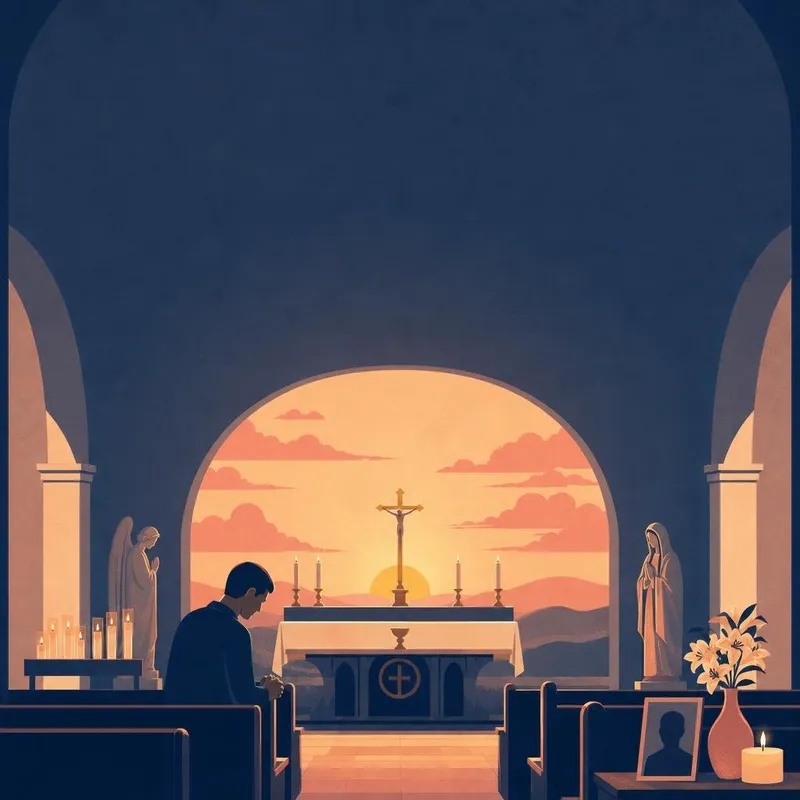
Catholics pray for the dead because those who die in God's friendship may still need purification before heaven, and the prayers of the living can help them. The greatest help is a Mass offered for the person; the Eternal Rest prayer, Psalm 130, the Rosary, almsgiving and indulgences also help, especially in November. You may pray for anyone who has died, including non-Catholics and those who died by suicide, and there is no point at which you must stop.
Praying for the dead means asking God to have mercy on people who have died and to bring them fully into his presence. Catholics do it at every Mass, at gravesides and in short daily prayers, because the Church teaches that the living can still help those they have lost.
It is one of the oldest Christian habits and one of the simplest. It needs no special training, only a name and a few words. This guide explains why the Church does it, the concrete ways to do it, and how long to keep going.
Why do Catholics pray for the dead?
Because death does not end the bond between Christians. The Church teaches that some who die in God's friendship still need purification before heaven, and that the prayers of the living can help them. Scripture records the practice, and the Church has kept it from the beginning.
The oldest witness is in the Old Testament. After a battle, Judas Maccabeus collected money for a sin offering for soldiers who had died wearing pagan amulets. The text says that if he had not expected the dead to rise, "it would have been superfluous and foolish to pray for the dead," and concludes: "Therefore he made atonement for the dead, that they might be delivered from their sin" (2 Maccabees 12:43 to 46).
Behind the practice is the communion of saints: the Church on earth, the souls being purified and the saints in heaven form one family. The Catechism says the Church "has honored with great respect the memory of the dead" since the earliest days and "offers her suffrages for them" (CCC 958). The Vatican's Directory on Popular Piety calls such prayer "a cultic expression of faith in the communion of saints" (Directory, 251).
The purification itself is what the Church calls purgatory. Those who undergo it "are indeed assured of their eternal salvation" (CCC 1030), and it "is entirely different from the punishment of the damned" (CCC 1031). Our post on what purgatory is explains the doctrine in full. Here it is enough to know that the dead we pray for are on their way to God, and that our prayer can speed them there.
What is the best way to help someone who has died?
Have a Mass offered for them. The Church has always placed the Eucharist first among prayers for the dead. Any parish office can arrange it: you give the name, the priest offers a Mass for that person, and you can attend if you wish.
The Catechism says the Church has offered prayers for the dead "above all the Eucharistic sacrifice" (CCC 1032), and that the Mass is offered for those who "have died in Christ but are not yet wholly purified" (CCC 1371). Our post on the Eucharist explains why the Mass carries this weight.
The most famous request for such a Mass comes from St. Monica, the mother of St. Augustine. Dying at Ostia, far from home, she told her sons: "Lay this body anywhere, let not the care for it trouble you at all. This only I ask, that you will remember me at the Lord's altar, wherever you be" (Augustine, Confessions IX, 27). Augustine records the request in his own account of her death, and the Catechism quotes it in its section on the Eucharist.
The Directory on Popular Piety lists the customary occasions: the funeral, then "the third, seventh, and thirtieth day" after death, "as well as on their anniversaries" (Directory, 255). Parishes usually suggest a small offering for a Mass intention. It supports the Church and its ministers; it does not buy anything, and canon law urges priests to offer Mass for the faithful "even if they have not received an offering" (can. 945).
Which prayers do Catholics say for the dead?
The most common is the Eternal Rest prayer, said at gravesides, after grace at meals and at the end of each decade of the Rosary. Others are Psalm 130, known by its Latin opening De profundis, the Rosary itself, and the Office of the Dead from the Liturgy of the Hours.
The Eternal Rest prayer. This is the standard English form: "Eternal rest grant unto them, O Lord, and let perpetual light shine upon them. May they rest in peace. Amen" (Vatican News, "Eternal Rest"). For one person, say "him" or "her" and add the name. The Directory notes that the formula Requiem aeternam "often accompanies the recitation of the Angelus, the rosary, and at prayers before and after meals" (Directory, 260).
Psalm 130, the De profundis. It opens "Out of the depths I cry to thee, O Lord" and turns on one line of hope: "If thou, O Lord, shouldst mark iniquities, Lord, who could stand? But there is forgiveness with thee" (Psalm 130). It is a classic prayer for the dead, and the Directory names it alongside the Requiem aeternam (Directory, 260).
The Rosary. Offer one decade for each person you are remembering, adding the Eternal Rest prayer at the end of each. Our guide to praying the Rosary has the full pattern. A nine-day novena for a person who has died is another long tradition.
The Office of the Dead. The Liturgy of the Hours has its own Morning and Evening Prayer for the dead, used at funerals and on All Souls' Day. Anyone can pray it from a breviary or a liturgy app.
Your own words count too. A short sentence at night, "Lord, have mercy on my father," is a real prayer for the dead.
How do almsgiving and indulgences help the dead?
Good works done for someone who has died can be offered to God on their behalf. The Church names almsgiving, acts of penance and indulgences as forms of help, alongside prayer. An indulgence obtained for a soul in purgatory is offered as an intercession, which God receives in his mercy.
The Catechism says the Church "commends almsgiving, indulgences, and works of penance undertaken on behalf of the dead" (CCC 1032). Because the dead being purified "are also members of the same communion of saints, one way we can help them is to obtain indulgences for them" (CCC 1479). In practice, almsgiving can be as simple as a donation to the poor in a person's memory.
The Church's handbook of indulgences says every indulgence, partial or plenary, can be applied to the dead by way of suffrage (Enchiridion Indulgentiarum, norm 3). Its concession for the faithful departed grants a partial indulgence for devoutly visiting a cemetery and praying for the dead, even only mentally, and for praying Lauds or Vespers of the Office of the Dead or the Eternal Rest prayer. On each day from November 1 to 8, the same cemetery visit carries a plenary indulgence, applicable only to the souls in purgatory (Enchiridion, concession 29).
A plenary indulgence needs the usual conditions: sacramental confession, Holy Communion, prayer for the Pope's intentions and freedom from attachment to any sin, even venial (Enchiridion, norm 20). It can be gained once a day (norm 18). Our post on what an indulgence is explains the conditions in detail.
Why is November the month of the dead?
Because it opens with All Saints' Day on November 1 and All Souls' Day on November 2, and the Church keeps the whole month as a time of prayer for the faithful departed. Parishes often keep a book of names near the altar and remember them at every Mass.
On November 2, the Directory says, the Church "incessantly offers the holy sacrifice of the Mass for the souls of all the faithful departed and prays the Liturgy of the Hours for them" (Directory, 255). It also names "the novena for the dead in preparation for the 2 November, and the octave prolonging it," as well as visits to the cemetery (Directory, 260). That octave lines up with the November 1 to 8 indulgence.
The Directory adds a caution. Cemetery visits should come "from the bonds existing between the living and the dead and not from any form of obligation, non-fulfilment of which involves a superstitious fear" (Directory, 260). Our post on All Saints' Day and All Souls' Day explains how the two feasts fit together.
Can you pray for non-Catholics and for those who died by suicide?
Yes to both. The Church prays for all the dead and places no limit on whom you may pray for. A priest may offer Mass for anyone who has died, Catholic or not, and the Catechism explicitly says the Church prays for people who have taken their own lives.
Canon law is direct: "A priest is free to apply the Mass for anyone, living or dead" (Code of Canon Law, can. 901). Praying for a Protestant grandmother, a Jewish friend or a parent who never believed is entirely in keeping with Catholic practice. "The Church prays that no one should be lost" (CCC 1058).
On suicide, the Catechism is especially gentle. "We should not despair of the eternal salvation of persons who have taken their own lives. By ways known to him alone, God can provide the opportunity for salutary repentance." It ends with a plain statement that the Church prays for them (CCC 2283). The preceding paragraph notes that "grave psychological disturbances, anguish, or grave fear of hardship, suffering, or torture can diminish the responsibility" of the person (CCC 2282). Families who have lost someone this way can have Masses offered and pray for them like anyone else.
Can you pray to the dead or ask them to pray for you?
Yes, with a distinction. Catholics ask the saints in heaven to intercede for them, and many also ask their own dead to pray for them. What the Church forbids is trying to contact the dead through mediums or séances, which it treats as divination.
The Catechism teaches that the saints "do not cease to intercede with the Father for us" (CCC 956). For those still being purified, it adds that our prayer for them "is capable not only of helping them, but also of making their intercession for us effective" (CCC 958). The Church has never formally defined whether souls in purgatory pray for the living, but asking them to is a widespread and permitted custom.
Speaking to a dead parent in prayer, telling them you miss them and asking them to pray for you, is part of that communion. Trying to summon them is a different act. The Catechism rejects "conjuring up the dead" and "recourse to mediums" (CCC 2116). Prayer goes through God. Divination tries to go around him.
How long should you keep praying for someone who has died?
There is no set limit. No one knows when a particular soul has completed its purification, so the Church encourages prayer for the dead without an end date. Many Catholics pray for their parents and grandparents for the rest of their lives, and no such prayer is ever wasted.
Purgatory belongs to the time "before the Final Judgment" (CCC 1031), and it cannot be measured in earthly days or years. Prayer offered in charity is never lost, and every Mass already prays for all the faithful departed. The Directory warns against treating the Mass as if it concerned only one's "own" dead (Directory, 255).
A sustainable pattern helps more than an intense one that fades. Say the Eternal Rest prayer for your dead every night, have a Mass offered on each anniversary, and visit the grave in November. St. Paul wrote that Christians should not "grieve as others do who have no hope" (1 Thessalonians 4:13). Praying for the dead is how that hope is practiced.
Common questions
What do you say when praying for someone who died? +
The simplest prayer is: "Eternal rest grant unto him, O Lord, and let perpetual light shine upon him. May he rest in peace. Amen." Add the person's name. You can also speak to God in your own words, asking him to forgive their sins and bring them into his presence.
Can I have a Mass said for someone who was not Catholic? +
Yes. Canon law states that a priest "is free to apply the Mass for anyone, living or dead" (can. 901). Contact any parish office, give the person's name and the date you would like, and ask whether an offering is customary.
Is it a sin to stop praying for the dead? +
No. Praying for a particular person who has died is an act of charity, not a precept with a fixed duration. The Church encourages it and builds it into every Mass, but no one sins by praying less for a particular person over time. Many Catholics keep a short daily prayer for all their dead.
Can souls in purgatory pray for us? +
The Church has not defined this. It teaches that our prayer for the dead can make "their intercession for us effective" (CCC 958), and asking the holy souls for their prayers is a long-standing, permitted custom.
Should I pray for someone I believe is already in heaven? +
You may. Only canonized saints and the blessed are declared by the Church to be in heaven, so for everyone else the Church keeps praying. Prayer offered in charity is never wasted, and the Mass is always offered for all the faithful departed.