When does the Christmas season end?
The Christmas season ends with the Feast of the Baptism of the Lord, the Sunday after Epiphany, which for Christmas 2026 is Sunday, January 10, 2027, and Ordinary Time begins the next day. The season starts on the evening of December 24 and holds the Christmas octave, January 1, Epiphany and the Baptism of the Lord. The twelve days and Candlemas on February 2 are older ways of counting, and the current calendar follows neither.
The Christmas season does not end on December 26, and it does not end with the twelve days either. In the Catholic calendar, Christmas Time runs from the evening of December 24 to the Feast of the Baptism of the Lord, the Sunday after Epiphany. For Christmas 2026 that Sunday is January 10, 2027.
This post gives the dates, explains what the Church celebrates between Christmas Day and the Baptism of the Lord, and sorts out two older answers you will still hear: the twelve days, and Candlemas on February 2.
When does the Christmas season end?
The Christmas season ends on the Feast of the Baptism of the Lord, the Sunday after Epiphany. For Christmas 2026 it falls on Sunday, January 10, 2027. Ordinary Time begins the next day, Monday, January 11, 2027, and runs until Lent.
The Universal Norms on the Liturgical Year state: "Christmas Time runs from First Vespers (Evening Prayer I) of the Nativity of the Lord up to and including the Sunday after Epiphany or after January 6" (Universal Norms 33). The official calendar of the United States bishops lists Sunday, January 10, 2027 as "The Baptism of the Lord", a feast in white vestments, and Monday, January 11 as a "Weekday (First Week in Ordinary Time)" in green (USCCB Liturgical Calendar 2027).
Pope Francis put the same rule in one sentence at the Angelus on this feast: "Today, at the conclusion of the Liturgical Season of Christmas, we celebrate the Feast of the Baptism of the Lord" (Angelus, 13 January 2019).
Because the end depends on Epiphany, which is kept on different days in different countries, the end of Christmas can differ by a week between countries. In 2027 it does not. Epiphany is Wednesday, January 6 in the universal calendar and Sunday, January 3 where it is moved to a Sunday, and in both cases the next Sunday is January 10.
When does the Christmas season begin?
The Christmas season begins on the evening of December 24, with First Vespers of Christmas and the Vigil Mass. The weeks before it are Advent, a season of preparation. That is why the Church keeps its celebration after December 25 rather than before it.
The Universal Norms give the starting point: "The Vigil Mass of the Nativity is used on the evening of December 24, either before or after First Vespers" (Universal Norms 34).
That order follows from what Advent is. Our post on Advent explains the four weeks of waiting, which in 2026 begin on Sunday, November 29. The Catechism describes Advent as the season in which the Church "makes present this ancient expectancy of the Messiah" (CCC 524). What is awaited in Advent is celebrated in Christmas Time, and the celebration takes more than one day.
What does the Church celebrate during the Christmas season?
The season holds the Christmas octave, eight days from December 25 to January 1, with the feasts of St. Stephen, the Holy Family and the Holy Innocents inside it. Then come the Solemnity of Mary, Mother of God on January 1, Epiphany, and the Baptism of the Lord, which closes the season.
The Directory on Popular Piety and the Liturgy sums up the season: "During Christmastide, the Church celebrates the mystery of the Lord's manifestation: his humble birth in Bethlehem which was made known to the shepherds", "the Epiphany to the three wise men", "the theophany at the river Jordan" and "the miracle of Cana" (Directory on Popular Piety and the Liturgy 106).
For Christmas 2026 the official calendar of the United States bishops gives these dates (USCCB Liturgical Calendar 2027):
- Friday, December 25: the Nativity of the Lord, a holy day of obligation.
- Saturday, December 26: St. Stephen, the first martyr, in red.
- Sunday, December 27: the Holy Family of Jesus, Mary and Joseph.
- Monday, December 28: the Holy Innocents, martyrs, in red.
- Tuesday to Thursday, December 29 to 31: days within the octave.
- Friday, January 1: the Solemnity of Mary, the Holy Mother of God, the octave day of Christmas and a holy day of obligation.
- Sunday, January 3: the Epiphany of the Lord in the United States. The universal date is Wednesday, January 6.
- Sunday, January 10: the Baptism of the Lord.
Two of these days oblige Catholics to attend Mass: Christmas Day and January 1. Our post on holy days of obligation explains how the rule works and which countries keep which days.
The octave ends where the civil year begins. The Church attaches a plenary indulgence to the public singing or recitation of the Te Deum on the last day of the year in thanksgiving, and of the Veni Creator on the first day of the year to ask God's help (Enchiridion Indulgentiarum, concession 26). Our post on indulgences explains what that means.
Why is Epiphany part of the Christmas season?
Epiphany, January 6, celebrates the showing of the newborn Christ to the nations in the wise men from the East. It belongs to Christmas because it completes the birth: the child born for Israel is revealed to the whole world. In the United States and many other countries it is moved to the Sunday between January 2 and 8.
The Catechism defines the feast: "The Epiphany is the manifestation of Jesus as Messiah of Israel, Son of God and Saviour of the world." The magi matter because of whom they stand for: "In the magi, representatives of the neighbouring pagan religions, the Gospel sees the first-fruits of the nations, who welcome the good news of salvation through the Incarnation" (CCC 528).
In the Gospel of the feast the wise men find the child and "they fell down and worshiped him. Then, opening their treasures, they offered him gifts, gold and frankincense and myrrh" (Matthew 2:11).
The date varies. In the universal calendar Epiphany is January 6, a Wednesday in 2027. Where it is not a holy day of obligation, bishops' conferences move it to the Sunday between January 2 and 8, so the calendar of the United States bishops lists "USA: The Epiphany of the Lord" on Sunday, January 3, 2027 (USCCB Liturgical Calendar 2027). Countries such as Italy, Spain and Poland keep January 6 itself as a holy day of obligation.
The feast has its own customs. The Directory names "the blessing of homes, on whose lentils are inscribed the Cross of salvation, together with the indication of the year and the initials of the three wise men (C+M+B), which can also be interpreted to mean Christus mansionem benedicat, written in blessed chalk" (Directory 118).
Why does the Baptism of the Lord close the Christmas season?
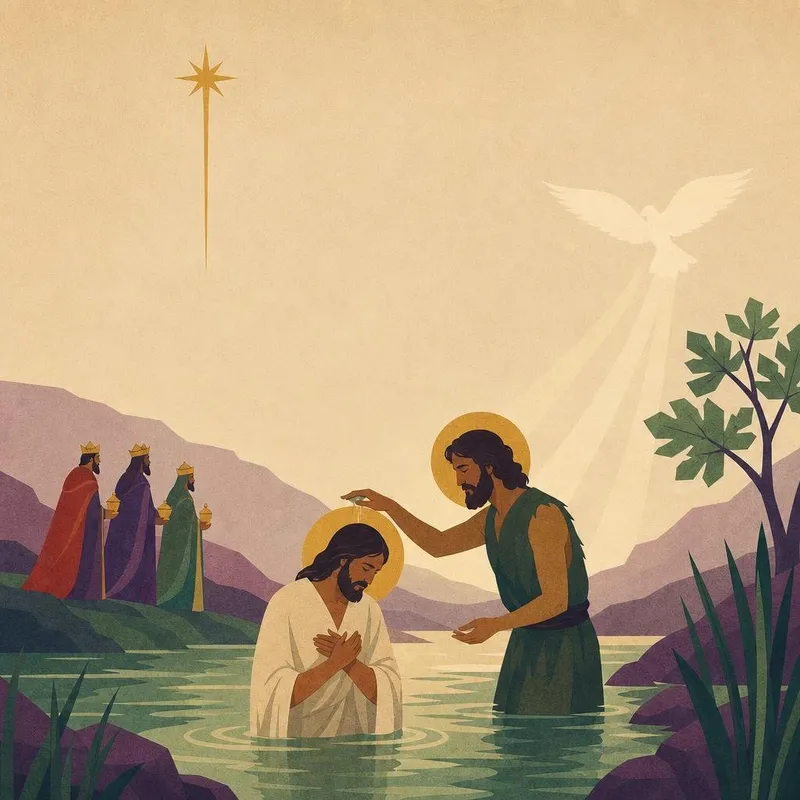
The Baptism of the Lord is the last of the Christmas manifestations. At the Jordan the Father's voice and the Spirit reveal who the child of Bethlehem is, and Jesus begins his public life. The season that began with his birth ends when his mission begins, and Ordinary Time follows the next day.
The Catechism treats the baptism as an Epiphany in its own right: "Jesus' public life begins with his baptism by John in the Jordan." After the Spirit comes down, "a voice from heaven proclaims, 'This is my beloved Son.' This is the manifestation ('Epiphany') of Jesus as Messiah of Israel and Son of God" (CCC 535). In Matthew's account the voice says: "This is my beloved Son, with whom I am well pleased" (Matthew 3:17). The Gospel read on January 10, 2027 is Mark's version, Mark 1:7 to 11 (USCCB Liturgical Calendar 2027).
The Directory draws the practical lesson: "Christmastide closes with the Baptism of the Lord," and "the feast presents an excellent opportunity for the faithful to be reminded of their rebirth as children of God in Baptism" (Directory 119). Pope Francis made it homework: "Today's celebration of the Baptism of the Lord concludes the Christmas Season and invites us to think about our baptism." He asked the crowd, "do you know the date of your baptism?" (Angelus, 7 January 2018). Our post on the seven sacraments explains what Baptism does.
Is Candlemas the end of the Christmas season?
Not any more. Candlemas, the Feast of the Presentation of the Lord on February 2, closed the Christmas season until 1969, forty days after Christmas. Since the calendar reform it falls in Ordinary Time. Many families still keep the crib up until then, and the Church does not object.
The Directory states the history: "Until 1969, the ancient feast of the presentation of Our Lord, which is of Oriental origin, was known in the West as the feast of the Purification of Our Lady, and closed the Christmas season, forty days after the Lord's birth" (Directory 120). In its list of the season's feasts the same document places the Presentation "although outside of Christmastide" (Directory 107). In 2027 it falls on Tuesday, February 2, a feast in white, with the Gospel of Luke 2:22 to 40 (USCCB Liturgical Calendar 2027).
The forty days come from the Gospel. Mary and Joseph bring the child to the temple "when the time came for their purification according to the law of Moses" (Luke 2:22). There the old man Simeon takes him in his arms and calls him "a light for revelation to the Gentiles, and for glory to thy people Israel" (Luke 2:32). The Catechism reads the scene as a last Christmas manifestation: "The presentation of Jesus in the temple shows him to be the firstborn Son who belongs to the Lord" (CCC 529).
That is why the feast still feels like Christmas, and why its candles are blessed as a sign of Christ, the light of the world. A family that leaves the crib up until February 2 is following a custom older than the present calendar, not breaking a rule.
What are the twelve days of Christmas?
The twelve days of Christmas are December 25 to January 5, the days between Christmas Day and the eve of Epiphany on January 6. The count is traditional, not a rule of the current calendar, which runs the season one Sunday further. For Christmas 2026 the season lasts seventeen days.
The count comes from the fixed date of Epiphany: twelve days from December 25 reach January 5, the old Twelfth Night. The current calendar neither shortens nor contradicts the twelve days. It absorbs them: the season runs "up to and including the Sunday after Epiphany or after January 6" (Universal Norms 33), so it always contains the twelve days and then some. From Friday, December 25, 2026 to Sunday, January 10, 2027 inclusive is seventeen days.
The Catechism explains why the birth of Christ gets a season rather than a day. The feasts around the Incarnation, "Annunciation, Christmas, Epiphany", "commemorate the beginning of our salvation and communicate to us the first fruits of the Paschal mystery" (CCC 1171). Christmas is the first chapter of Easter, and a first chapter needs room.
How do Catholics keep the Christmas season at home?
Keep celebrating after December 25 rather than before it. Leave the crib and the tree up until the Baptism of the Lord, go to Mass on January 1, sing the Te Deum on December 31, bless the home at Epiphany, and find out the date of your own baptism. Only the two holy days are obligatory.
The crib comes first. The Catechism says of the first Christmas: "Jesus was born in a humble stable, into a poor family. Simple shepherds were the first witnesses to this event. In this poverty heaven's glory was made manifest" (CCC 525). The Directory recommends "the inauguration of the crib in the homes of the faithful which is an opportunity for family prayer", with "a reading of St. Luke's account of the birth of Christ" and "the typical Christmas carols" (Directory 109). A crib that goes up on December 24 and comes down on January 10 has kept the whole season.
The season ends in the heart. "Only when Christ is formed in us will the mystery of Christmas be fulfilled in us," the Catechism says, calling Christmas "the mystery of this 'marvellous exchange'" in which God's Son took our humanity so that we might share his divinity (CCC 526). The calendar sets a date for the end of the season. The exchange has none.
Common questions
When does the Christmas season end in 2027? +
On Sunday, January 10, 2027, the Feast of the Baptism of the Lord. Ordinary Time begins on Monday, January 11, 2027 and runs until Ash Wednesday, February 10, 2027 (USCCB Liturgical Calendar 2027).
When is Epiphany in 2027? +
In the universal calendar Epiphany is Wednesday, January 6, 2027. In the United States and other countries where it is not a holy day of obligation, it is celebrated on Sunday, January 3, 2027 (USCCB Liturgical Calendar 2027).
Is January 1 a holy day of obligation? +
Yes. January 1 is the Solemnity of Mary, the Holy Mother of God, the octave day of Christmas, and the official calendar marks it as a holy day of obligation (USCCB Liturgical Calendar 2027). In 2027 it falls on a Friday.
When should Catholics take down the Christmas tree and the nativity scene? +
There is no rule. The liturgical season ends on January 10, 2027, and many families take the decorations down that evening. Others keep the crib until Candlemas, February 2, which "closed the Christmas season" until 1969 (Directory 120).
Is Candlemas part of the Christmas season? +
Not since the 1969 calendar. The Directory on Popular Piety lists the Presentation of the Lord on February 2 "although outside of Christmastide" (Directory 107). It remains a feast of the Lord with its blessing of candles.
When does Ordinary Time start in 2027? +
On Monday, January 11, 2027, the day after the Baptism of the Lord. Its first stretch ends on Tuesday, February 9, the day before Ash Wednesday (USCCB Liturgical Calendar 2027). It resumes after Pentecost and ends with Christ the King.